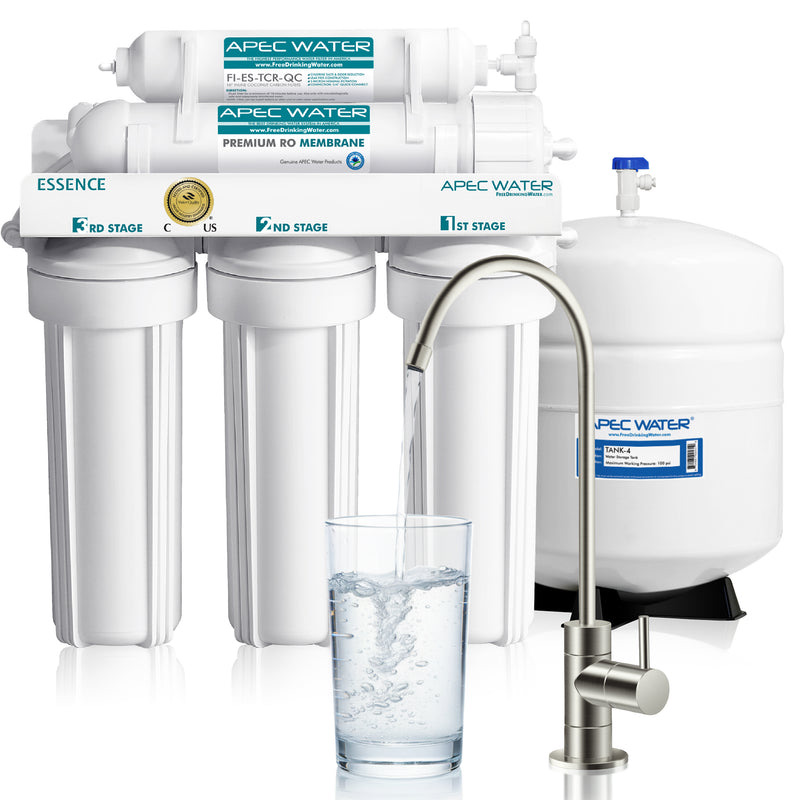
APEC ROES-50 vs iSpring RCC7: Best Budget Under-Sink RO Filter Head-to-Head
The APEC ROES-50 and iSpring RCC7 are the two best-selling under-sink reverse osmosis systems on Amazon. Combined, they've shipped to more than 2 million households. Both cost under $250. Both run 5-stage filtration through a 0.0001-micron membrane. Both hold NSF/ANSI 58 certification.
So why does one outsell the other in certain regions, and which one is actually worth buying in 2026? This comparison breaks down the real differences in daily output, wastewater ratio, installation, filter costs, and long-term ownership -- not the marketing summary.
Affiliate Disclosure: WaterFilterGeek participates in the Amazon Services LLC Associates Program. We earn commissions from qualifying purchases through our Amazon links at no extra cost to you. We recommend products based on specifications, performance, and value, not commission rates.
Quick Picks: Which RO System Is Right for You?
| System | Daily Output | Certifications | Best For | Price |
|---|---|---|---|---|
| APEC ROES-50 | 50 GPD | NSF/ANSI 58 + WQA Gold Seal | 1-3 person households, certification-first buyers, low-pressure lines | Check Price on Amazon |
| iSpring RCC7 | 75 GPD | NSF/ANSI 58 | Families of 4+, solo DIY installers, faster tank refill | Check Price on Amazon |
| iSpring RCC7AK | 75 GPD | NSF/ANSI 58 | Households who dislike flat RO water taste (adds minerals back) | Check Price on Amazon |
Full Specifications Side-by-Side
| Specification | APEC ROES-50 | iSpring RCC7 |
|---|---|---|
| Filter Stages | 5 | 5 |
| Daily Output (GPD) | 50 GPD at 60 PSI | 75 GPD at 60 PSI |
| Membrane Rating | 0.0001 micron TFC (DuPont FilmTec) | 0.0001 micron TFC |
| Storage Tank | 4-gallon nominal (3.2 usable) | 3.2-gallon nominal (2.5 usable) |
| Waste Ratio | 3:1 at 60 PSI | 2.5:1 to 3:1 depending on pressure |
| NSF Certification | NSF/ANSI 58 + WQA Gold Seal | NSF/ANSI 58 |
| TDS Rejection | 96-99% | 95-98% |
| Operating Pressure | 40-85 PSI (optimal: 60 PSI) | 45-80 PSI (optimal: 60 PSI) |
| Assembly | USA (City of Industry, CA) | Designed in USA, assembled in Asia |
| Warranty | 1 year (2 years with registration) | 1 year limited |
| Annual Filter Cost | ~$60-80 | ~$60-85 |
| Current Price | ~$199-229 | ~$229-259 |
Where They Actually Differ
Daily Output: iSpring Wins by 50%
The iSpring RCC7's 75 GPD membrane produces half again as much purified water per day as the APEC's 50 GPD. For a family of four who cooks pasta, fills a coffee maker, runs a sous vide, and drinks 3-4 liters daily, 50 GPD is often enough -- but after heavy use, the APEC's tank refill time is noticeably longer.
The math: at 50 GPD, the APEC produces roughly 2.1 gallons per hour when the membrane is actively filtering. The iSpring produces about 3.1 gallons per hour. After you drain the storage tank cooking a big meal, the iSpring gets back to full capacity faster.
For a 1-2 person household, 50 GPD is more than sufficient. For families of 4 or more with high daily water use, the iSpring's output headroom matters.
Storage Tank: APEC Has 28% More Usable Capacity
The APEC ships with a 4-gallon nominal tank (3.2 gallons usable). The iSpring ships with a 3.2-gallon nominal tank (approximately 2.5 gallons usable). The automatic shut-off valve on both systems triggers at roughly 65% of inlet line pressure -- meaning the last portion of the tank isn't pressurized enough to flow through the faucet.
In practical terms: the APEC delivers more water before it starts refilling. The iSpring compensates with faster membrane output. Either way, both tanks refill overnight.
Waste Ratio: Basically Tied
At 60 PSI, both systems discharge approximately 3 gallons to drain for every 1 gallon of purified water stored. The iSpring can achieve 2.5:1 at higher inlet pressures above 65 PSI, but neither system includes a permeate pump. If you want meaningful water savings, you'd need to add an aftermarket pump to either system.
For city water on a flat-rate municipal bill, the wastewater cost is negligible. At $0.01 per gallon average US municipal rate, the daily wastewater cost runs about $0.09 per day for the APEC and $0.11 per day for the iSpring -- less than $35 per year either way.
Certifications: APEC Has the Edge
The APEC ROES-50 carries both NSF/ANSI 58 certification (TDS reduction, contaminant rejection) and WQA Gold Seal certification. The WQA certification requires independent third-party laboratory testing and manufacturing facility inspection -- it's a higher bar than NSF listing alone.
The iSpring RCC7 base SKU (B008GNRMYK) holds NSF/ANSI 58 for TDS reduction. The finish-variant SKUs (RCC7-BLK, RCC7-BN) carry additional certifications for asbestos, barium, fluoride, and lead -- but the standard chrome model does not. Worth knowing if certification specifics matter to your water testing results.
Both remove lead, fluoride, arsenic, PFAS, and chlorine in practice. The certification difference matters most in commercial, rental, or regulatory contexts where paperwork is required.
Installation: iSpring Is Marginally Easier
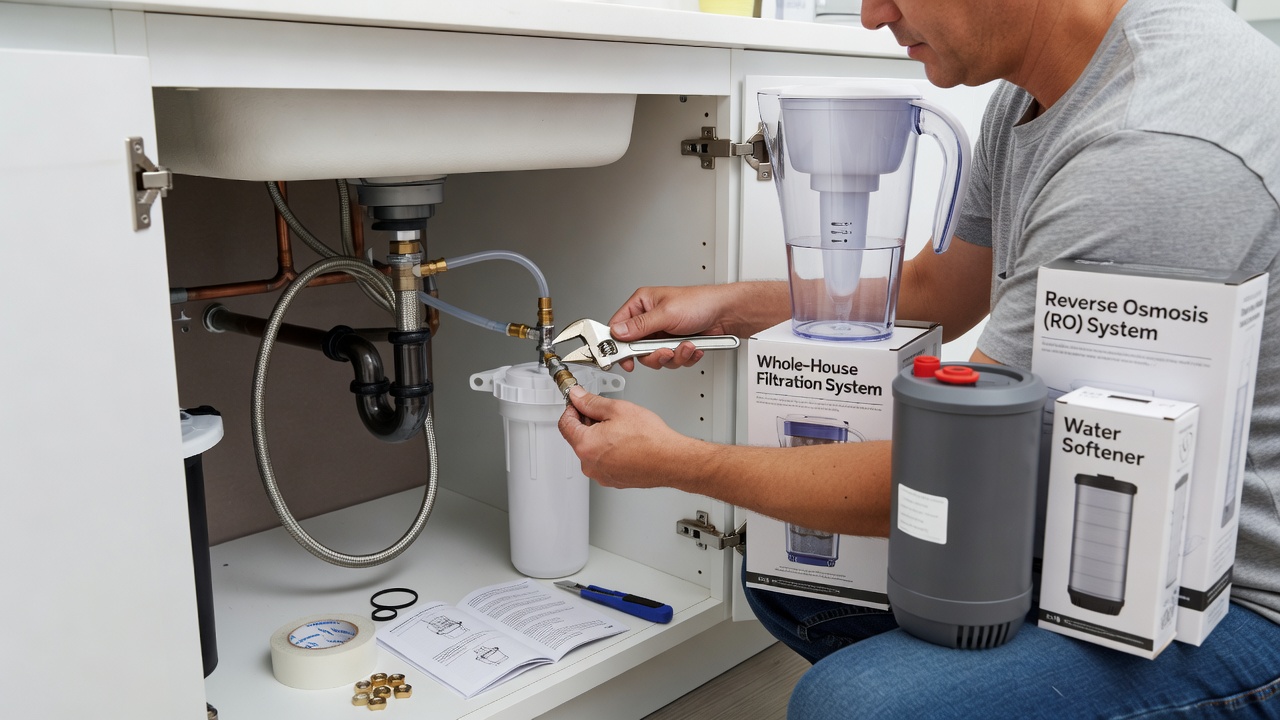
Both are DIY-installable without a plumber. The standard steps for each:
- Shut off cold water supply under the sink
- Install a saddle valve or T-adapter on the cold supply line (both include this)
- Mount the filter assembly and storage tank under the sink
- Drill a hole for the dedicated faucet (if the sink doesn't have a spare hole)
- Connect color-coded supply, drain, and tank tubing
- Run the drain line to the sink drainpipe with a drain saddle
The iSpring's advantage: its patented top-mounted faucet tightens from above the sink deck with a single nut -- accessible without getting under the sink. The APEC uses a standard under-deck faucet nut that requires working underneath. For solo installers without a helper, the iSpring saves 20-30 minutes of contortion.
Both include all hardware, color-coded tubing, filter housing wrench, Teflon tape, drain saddle, and installation manual. Expect 1.5 to 2.5 hours for a first-time installer on either system.
Countertop material matters: If you need to drill through granite or quartz for the faucet, hire a plumber for that step regardless of which system you choose. A diamond-tipped core bit costs $50-80 to rent, and a cracked granite countertop costs $400-800 to replace.
Filter Replacement Costs (5-Year Breakdown)
APEC ROES-50 Filter Schedule
| Stage | Interval | Cost/Replacement | 5-Year Total |
|---|---|---|---|
| Stages 1-3 pre-filter set (sediment + 2x carbon) | 6-12 months | ~$35 | ~$175-210 |
| RO membrane (DuPont FilmTec) | 2-4 years | ~$45 | ~$45-90 |
| Stage 5 post-carbon | 12 months | ~$12 | ~$60 |
5-year filter total: ~$280-360
iSpring RCC7 Filter Schedule
| Stage | Interval | Cost/Replacement | 5-Year Total |
|---|---|---|---|
| Stages 1-3 (sediment, GAC, carbon block) | 6 months | ~$29 | ~$145-175 |
| RO membrane (MC7) | 2-3 years | ~$39 | ~$39-78 |
| Stage 5 post-carbon (FT15) | 6-12 months | ~$13 | ~$65-130 |
5-year filter total: ~$249-383
Filter costs over five years are nearly identical for both systems. The APEC's stages 1-3 filters last slightly longer (6-12 months vs. the iSpring's recommended 6-month interval), but the iSpring's individual filter prices are slightly lower. Over a five-year period the difference is $30-60 -- not a deciding factor.
Total Cost of Ownership (5 Years)
| APEC ROES-50 | iSpring RCC7 | |
|---|---|---|
| Purchase price | ~$209 | ~$239 |
| DIY installation | $0 | $0 |
| 5-year filters | ~$320 | ~$316 |
| 5-year total (DIY) | ~$529 | ~$555 |
| Professional install | +$150-250 | +$150-250 |
At 5 years, the APEC is roughly $25 cheaper, primarily because of its lower purchase price. If the iSpring goes on sale -- it frequently does -- the gap closes to nothing. Long-term cost is not a meaningful differentiator here. Buy based on output needs and certification preference, not 5-year spreadsheet math.
Well Water Compatibility
Both systems handle well water with an important caveat: well water with iron above 0.3 ppm, manganese above 0.05 ppm, or hydrogen sulfide (rotten egg smell) will foul the RO membrane within months without pre-treatment. Neither system includes an iron or sulfur pre-filter.
If your well water has these issues, add a whole-house sediment filter on your main line upstream of the RO. The iSpring WGB32B (a separate 3-stage whole-house unit) is a popular pairing. Without pre-treatment, membrane replacement frequency doubles or triples, erasing any cost savings.
For standard well water without iron or sulfur issues -- just high TDS, nitrates, or hardness -- both systems perform well. They'll reduce TDS from 300-500 ppm (common in rural well water) to under 20 ppm at the tap.
Renter Considerations
Both systems connect to the existing cold supply line under the sink and drain through a saddle valve on the drain pipe. Neither requires cutting plumbing or permanent modifications that would violate most lease agreements. The faucet hole is the main issue: if your sink doesn't have a spare hole and you can't drill one, consider a countertop RO instead.
If you rent and need a no-drill option, read our APEC ROES-50 vs Waterdrop G3 comparison -- the Waterdrop tankless models eliminate the storage tank and mount entirely under the sink without a dedicated faucet hole requirement on some countertop configurations.
When to Choose the APEC ROES-50
- Your household uses 2 gallons of filtered water per day or less
- You want dual NSF + WQA certification on the paperwork
- Your inlet water pressure runs 40-55 PSI (the APEC tolerates lower pressure better)
- You prefer USA-assembled equipment and APEC's domestic customer support
- You've had RO systems before and don't mind standard under-deck faucet installation
Check Current APEC ROES-50 Price on Amazon
When to Choose the iSpring RCC7
- Your household of 4 or more goes through 4+ gallons of filtered water daily
- You want the highest daily output in the under-$250 class
- You're installing solo and want the easier top-mount faucet setup
- You want a transparent 1st-stage housing to visually monitor sediment filter condition
- You're considering upgrading later to the RCC7AK (alkaline remineralization) variant
Check Current iSpring RCC7 Price on Amazon
Consider the iSpring RCC7AK If Taste Matters Most
Standard RO water tastes flat because the membrane strips virtually all minerals, including calcium and magnesium. The RCC7AK adds a 6th stage -- an alkaline remineralization cartridge -- that adds minerals back and raises pH to approximately 7.5-8.5. If you or someone in your household finds RO water "too clean" or prefers the taste of mineral water, the AK variant is a $30-40 premium over the base RCC7 that's worth it.
Check Current iSpring RCC7AK Price on Amazon
Frequently Asked Questions
Which removes more contaminants -- APEC ROES-50 or iSpring RCC7?
Both remove 99% of over 1,000 contaminants including lead, fluoride, arsenic, PFAS, and chlorine. The APEC holds dual NSF/ANSI 58 and WQA Gold Seal certification with no detected leaching in independent tests. The iSpring RCC7 showed trace leaching of boron, vanadium, and aluminum (all below health limits) in one comparative test. For the vast majority of households, performance is functionally equivalent.
Which RO system wastes less water -- APEC or iSpring?
At standard 60 PSI, both run close to a 3:1 waste-to-purified ratio. The iSpring RCC7 can achieve 2.5:1 at inlet pressures above 65 PSI. Neither system includes a permeate pump. If water conservation is the priority, a tankless RO with a built-in pump is a better choice -- see our Waterdrop G3 comparison.
Is the APEC ROES-50 or iSpring RCC7 easier to install?
The iSpring RCC7 is slightly easier for solo installers. Its patented top-mounted faucet tightens from above the sink deck rather than underneath. Both use color-coded quick-connect tubing and include all necessary hardware. Either system takes 1.5 to 2.5 hours for a first-time DIY installer.
Which budget RO system has lower long-term filter costs?
Annual filter costs are nearly identical -- approximately $60 to $80 per year for both systems. Over five years, expect $280-380 in filter costs for either system. The difference between the two is less than $60 over five years -- not a meaningful deciding factor.
Can I use the APEC ROES-50 or iSpring RCC7 on well water?
Yes, but only with a sediment pre-filter upstream if iron, manganese, or hydrogen sulfide is present. Run a water test first. If iron exceeds 0.3 ppm or hardness exceeds 7 gpg, add a dedicated pre-filter before the RO to protect the membrane. Without pre-treatment on problem well water, membrane life drops from 2-4 years to 6-12 months.
Which system produces more water per day?
The iSpring RCC7 produces 75 GPD versus the APEC ROES-50's 50 GPD -- 50% more output daily. For a household of 4 or more who cook frequently, the iSpring refills the tank faster after heavy use. For 1-3 person households, the APEC's 50 GPD with its larger 4-gallon tank is sufficient for most daily water needs.
The 2026 Verdict
These are genuinely close systems. Both deliver NSF-certified RO water at under-$250 entry prices with nearly identical long-term ownership costs. The decision comes down to two variables:
Choose APEC ROES-50 if you want the stronger certification package (WQA Gold Seal + NSF 58), USA-assembled hardware, and your household uses moderate daily water volume. The larger 4-gallon storage tank also means fewer refill cycles for average use. Check Current APEC ROES-50 Price on Amazon
Choose iSpring RCC7 if you have a family of 4 or more, want the easier solo install, or need the higher 75 GPD daily output. If you want alkaline remineralized water, step up to the RCC7AK for $30-40 more. Check Current iSpring RCC7 Price on Amazon
Either system will dramatically reduce your water's TDS, eliminate lead and fluoride, and produce water that tastes better than what comes out of the tap. The differences are real but minor. Don't overthink it -- pick based on household size and installation preference, then enjoy the water.
Related Guides
- APEC ROES-50 vs Waterdrop G3: Tankless vs Tank-Based RO
- SpringWell CF1 vs iSpring RCC7: Whole-House vs Under-Sink
- Best Water Filters for Lead Removal: NSF 53 Certified Picks
- Best Whole House Water Filters Under $500
Affiliate Disclosure: WaterFilterGeek participates in the Amazon Services LLC Associates Program, an affiliate advertising program designed to provide a means for sites to earn commissions by linking to Amazon.com. We earn commissions from qualifying purchases made through our Amazon links at no additional cost to you. These commissions support our research, testing, and content creation. We recommend products based on specifications, performance, and value, not commission rates.
Photos provided by Pexels.