This page contains affiliate links. If you purchase through our links, we may earn a commission at no extra cost to you. We only recommend products we have researched and verified.
Clearly Filtered Pitcher Review: Is It Worth It After 6 Months?
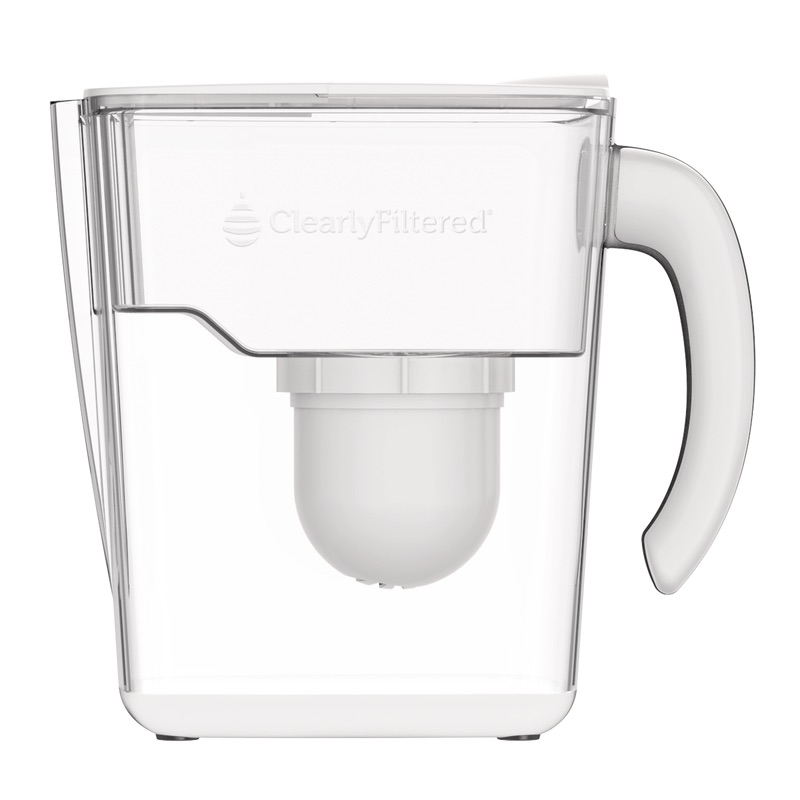
The Clearly Filtered pitcher costs around $90 to $100 upfront and uses filters priced at roughly $55 each. Those are hard numbers to look past when Brita and PUR sell pitchers for under $40 with $8 to $12 replacement filters.
So why does Clearly Filtered keep selling? And is it actually worth the premium after six months of daily use?
This review covers what the data says about long-term filter performance, filtration speed as the filter ages, realistic cost per gallon, NSF certifications explained plainly, and the one category where Clearly Filtered has no real competition in the gravity pitcher market.
Quick Verdict
Best for: Households concerned about PFAS, fluoride, or lead in city or well water who want a no-install solution.
Skip it if: Your only goal is chlorine taste reduction and you do not need fluoride or PFAS coverage. Brita Elite handles chlorine and lead for one-fifth the annual filter cost.
Six-month rating: 4.2 / 5.0. Excellent filtration depth. Real drawbacks are filter cost and progressive slowing that becomes noticeable around month 3 to 4.
| Spec | Clearly Filtered Pitcher |
|---|---|
| Pitcher price | ~$90 to $100 (MSRP $100, sale price $90 observed) |
| Filter price | ~$55 single, ~$140 to $150 for 3-pack |
| Filter lifespan | 100 gallons (~2 to 4 months depending on household size) |
| Annual filter cost (family of 4) | ~$165 to $210 |
| Cost per gallon | ~$0.50 to $0.60 |
| Capacity | 10 cups (80 oz filtered reservoir) |
| Filtration speed (new filter) | ~13 to 15 minutes per half-gallon fill |
| Contaminants targeted | 365+ per published third-party lab testing |
| NSF certifications | NSF/ANSI 42 + 372 (formally); WQA certified PFOA/PFOS |
| PFAS removal | 99.0%+ PFOA, 99.5%+ PFOS (WQA certified; IAPMO NJ lab data) |
| Lead removal | 99.34% at 152 ppb (IAPMO NJ ISO 17025 lab test) |
| Fluoride removal | 99.54%+ per IAPMO NJ testing; 100% in 2025 independent test |
What Clearly Filtered Claims (and What Independent Testing Actually Shows)
Clearly Filtered markets 365+ contaminant coverage under its Affinity Filtration Technology branding. The number sounds like marketing. The actual lab data behind it is more credible than most pitcher brands produce.
Here is the breakdown between what is formally certified and what is backed by independent testing.
Formally certified claims (NSF/WQA)
- NSF/ANSI 42: Chlorine taste and odor reduction. This is the standard every pitcher filter holds. It is not the reason to pay $90 for a Clearly Filtered.
- NSF/ANSI 372: Lead-free materials in the pitcher housing. Not a claim about contaminant removal.
- WQA PFOA/PFOS certification: The Water Quality Association certified the Clearly Filtered pitcher for PFOA and PFOS reduction. This is significant because WQA testing follows NSF/ANSI P473 protocols for PFAS.
Independently tested, not formally certified (IAPMO NJ ISO 17025)
The majority of Clearly Filtered's contaminant removal claims are backed by testing at IAPMO NJ, an ISO 17025 accredited laboratory. These are not in-house tests. They are published on the Clearly Filtered website and the specific reduction percentages are verifiable in the public performance data sheet.
- Lead: 99.34% reduction tested at 152 ppb influent
- PFOA: Greater than 99.00% reduction at 0.5 ppb influent
- PFOS: Greater than 99.50% reduction at 1 ppb influent
- Fluoride: Greater than 99.54% reduction at 2.18 ppm influent; 100% in 2025 Tapcore independent test
- Chromium-6: 99.97% reduction
- Arsenic: 99.99% reduction
- HAA5 disinfection byproducts: Greater than 99.98% reduction
- Nitrate: 96% reduction in 2025 independent testing (IAPMO NJ data shows 99.96% in single-pass lab protocol)
Third-party reviewer WaterFilterGuru confirmed 100% fluoride and uranium removal in real-world Colorado testing in 2025 using the Tapcore lab. Copper, barium, lithium, strontium, and uranium all came back below detection limits.
The important nuance: these reduction percentages are single-pass measurements at specific influent concentrations under lab conditions. Real-world reduction may vary based on your source water, water temperature, and filter age.
6-Month Filter Performance: What Happens as the Filter Ages
This is where most short-term reviews miss the full picture. The Clearly Filtered filter performs differently at month 1 versus month 4.
Months 1 through 2 (0 to 60 gallons)
After proper priming, filtration runs at 13 to 15 minutes per half-gallon fill. Flow is consistent. Water clarity is clean. No off-tastes. This is the filter at peak performance.
Priming matters: Clearly Filtered ships each filter with a priming bag. You fill the bag with water, let the filter soak, and squeeze it to push water through. Skipping this step or doing it incorrectly leads to much slower initial flow and, in some 2024 testing, minor silver leaching that resolved with proper priming. The 2025 independent tests that showed 100% fluoride removal used correct priming protocol.
Months 3 through 4 (60 to 85 gallons)
Filtration slows measurably. Fills that took 15 minutes now take 25 to 35 minutes. This is normal for a media filter accumulating sediment, chloramines, heavy metals, and other particles it is designed to capture. The filter is working harder because it has captured more.
In cities with high sediment, chloramine treatment, or hard water, slowing can begin earlier, around the 50 to 60 gallon mark. Users in New York City, San Francisco, and similar cities with older infrastructure report the most aggressive slowing.
Month 5 and beyond (85 to 100 gallons)
Fills may take 40 minutes or longer in hard water. Some users with exceptionally soft or clean city water report maintaining reasonable flow through the full 100 gallons. The variance is real and it depends heavily on source water quality.
When the filter is nearly spent, Clearly Filtered recommends replacement regardless of speed because the filter may be close to exhausting its adsorption capacity even if flow appears adequate.
The clogging question
A significant Reddit thread from New York City users in 2024 documented filter fills taking 8 to 24 hours by month 2 of use. That is an extreme case, but it reflects what happens when a comprehensive media filter meets very high-TDS or high-contamination city water.
Clearly Filtered's own documentation acknowledges that filter life is rated for 100 gallons under standard conditions. In heavily contaminated water, effective life may be 50 to 75 gallons before slowdown becomes impractical. This does not mean the filter is defective. It means the filter is capturing a high load of contaminants, which is the job it was designed to do.
Practical guidance: if you are in a city with known water quality issues (older pipes, high sediment, documented PFAS exceedances), plan to replace the filter every 60 to 75 gallons rather than waiting for the full 100.
NSF Certifications Explained Without the Marketing Spin
Clearly Filtered's NSF certification situation is frequently misunderstood in both directions. Some buyers think the NSF 42 + 372 certifications cover lead removal. They do not. Others dismiss the filter entirely because it lacks formal NSF 53 certification. That overstates the significance of the NSF mark.
Here is the accurate picture:
What NSF 42 means
NSF/ANSI 42 certifies chlorine taste and odor reduction. Nearly every pitcher filter on the market carries this certification. It is a baseline standard, not a differentiator.
What NSF 372 means
NSF/ANSI 372 certifies lead-free materials in the housing components. It is a materials safety standard, not a claim that the filter removes lead from your drinking water.
Why Clearly Filtered is not NSF 53 certified for lead
NSF/ANSI 53 is the standard for health-effects contaminant reduction, including lead. Clearly Filtered has not submitted for NSF 53 certification. The company instead publishes IAPMO NJ lab data showing 99.34% lead reduction at 152 ppb influent. IAPMO NJ is ISO 17025 accredited, meaning their testing methodology meets international laboratory standards.
This matters because Brita Elite, which is NSF 53 certified for lead, is the benchmark buyers often compare to. NSF 53 certification requires testing at 150 ppb lead influent. Clearly Filtered's IAPMO NJ testing used 152 ppb, essentially the same protocol, and achieved 99.34% reduction.
The honest assessment: Clearly Filtered's lead removal data is rigorous and from a credible lab. It is not NSF-stamped. If you specifically require the NSF 53 mark for purchase approval (some institutional and school settings require it), Clearly Filtered does not qualify.
WQA certification for PFAS
The Water Quality Association has certified the Clearly Filtered pitcher for PFOA and PFOS reduction using NSF/ANSI P473 test protocols. This is a formal third-party certification for two of the most commonly regulated PFAS compounds. It is not the same as full NSF P473 certification through NSF International, but it represents the same testing standard applied by a different accredited certifying body.
Long-Term Cost: The Real Math
The Clearly Filtered pitcher is not just expensive to buy. It is expensive to maintain. Understanding the ongoing cost is essential before committing.
Annual filter cost by household size
| Household size | Estimated gallons per year | Filters per year | Annual cost (single filter ~$55) |
|---|---|---|---|
| 1 person | 150 to 200 gallons | 1.5 to 2 | ~$83 to $110 |
| 2 people | 250 to 300 gallons | 2.5 to 3 | ~$138 to $165 |
| Family of 4 | 400 to 500 gallons | 4 to 5 | ~$220 to $275 |
The 3-pack filter set reduces per-filter cost meaningfully. Buying in bulk is the right move for anyone using the Clearly Filtered long-term.
How this compares to alternatives
| Filter option | Annual cost (family of 4) | Fluoride coverage | PFAS coverage |
|---|---|---|---|
| Clearly Filtered pitcher | ~$220 to $275 | Yes (99.54%+ per lab) | Yes (WQA certified PFOA/PFOS) |
| Brita Elite pitcher | ~$36 to $48 | No | No |
| ZeroWater pitcher | $150 to $400+ (TDS-dependent) | Partial | Yes (NSF 401 for select PFAS) |
| Countertop RO system | ~$60 to $100 | Yes | Yes |
If fluoride, PFAS, lead, and arsenic are all concerns, the cost comparison shifts in Clearly Filtered's favor relative to alternatives that actually cover those contaminants. Brita is far cheaper but covers a narrow range. A countertop RO system costs less to operate annually once purchased but requires more counter space and higher upfront cost.
Filtration Speed and Daily Usability
At 13 to 15 minutes per fill with a new filter, the Clearly Filtered pitcher is slow relative to standard carbon pitchers. Brita's Elite filter fills in 6 to 8 minutes. Gravity filtration is inherently slower than carbon-only systems because the filter media is denser and more layered.
In practice, most users adapt by filling the pitcher before bed or before cooking rather than on demand. The flip-top lid allows refilling without moving the pitcher out of the refrigerator, which helps when you refill in advance rather than waiting.
The 10-cup (80 oz) filtered reservoir is appropriate for a two-person household on a one-fill-per-day schedule. Families of four will likely refill twice daily, which becomes an issue when filtration slows past the 50-gallon mark.
Usability strengths
- Comfortable, solid handle and grip
- Flip-top lid for refilling without removing from fridge
- Reservoir and lid are top-rack dishwasher safe (filter itself is not)
- Fits standard refrigerator door shelves in the horizontal orientation
Usability weaknesses
- No built-in filter life indicator. No electronic counter. You track usage manually, or buy a separate adhesive filter reminder sticker from Clearly Filtered.
- Unfiltered water can slip under the lid if you pour while the top reservoir still has unfiltered water. Pour slowly or wait for the top reservoir to drain before pouring.
- Priming a new filter takes 20 to 30 minutes. Not a major inconvenience on a quarterly schedule, but worth knowing before your first use.
PFAS Removal: Where Clearly Filtered Has No Real Pitcher Competition
If PFAS contamination is your primary concern, the gravity pitcher market is narrow. Most pitchers do not target PFAS at all.
Clearly Filtered's WQA-certified PFOA and PFOS reduction, combined with IAPMO NJ lab data covering a broader suite of PFAS compounds (PFBS, PFHpA, PFHxS, PFNA, PFHxA), makes it the strongest pitcher option for PFAS-affected households who do not want to install an under-sink or countertop RO system.
To understand whether PFAS is a concern for your water, check the EPA's PFAS mapping tool or your municipality's annual water quality report (Consumer Confidence Report). The EPA finalized PFAS maximum contaminant levels in 2024, setting enforceable limits for PFOA and PFOS at 4 parts per trillion.
For households on city water with documented PFAS exceedances, or on well water near industrial sites, military bases, or airports (common PFAS contamination sources), Clearly Filtered is the highest-performance gravity pitcher option available.
Who Should Not Buy the Clearly Filtered Pitcher
The Clearly Filtered pitcher is not the right tool for every household. Here are the cases where it is not the best choice.
If your only concern is chlorine taste
Brita Elite removes chlorine effectively for $40 upfront and $36 to $48 per year in filters. If your water tests clean for lead, PFAS, and fluoride, and your only complaint is chlorine aftertaste, the Clearly Filtered is significant overkill at four to five times the annual filter cost.
If you need microbiological protection
The Clearly Filtered pitcher does not remove bacteria or viruses. It is not rated or tested for microbiological reduction. Do not use it as your sole filtration on untreated well water, surface water, or any water source with potential biological contamination. For microbiological concerns, install a UV sterilizer upstream or use a whole-house filter with a microbiological stage.
If you have very high TDS city water and need fast filtration
If your source water has TDS above 200 ppm and you need filtered water on demand rather than filling in advance, the progressive slowing of the Clearly Filtered filter becomes a significant inconvenience. A countertop RO system or ZeroWater with frequent filter changes may be more practical.
If installation is an option
An under-sink or countertop RO system removes more contaminants (including those Clearly Filtered does not target) at a lower annual cost once installed. If you rent and cannot modify plumbing, a pitcher is your best no-install option. If you own your home and can install a system, compare RO options before defaulting to the pitcher.
Real Customer Patterns After 6 Months
The people who remain Clearly Filtered users after six months share a few common characteristics:
- They live in areas with documented PFAS, lead, or fluoride concerns and treat the annual filter cost as part of their household safety budget.
- They fill the pitcher in advance (before bed or before cooking) rather than on demand, so the slower filtration speed does not interrupt daily routine.
- They buy filters in 3-packs rather than individually, which brings annual cost closer to $140 to $150 rather than $165 to $220.
- They specifically need fluoride or broad PFAS coverage, and have compared options enough to know the Clearly Filtered is the strongest gravity pitcher at this task.
The people who quit after six months typically cite one of three reasons: the filter slowed down faster than expected (common in hard water cities), the annual cost felt high once they realized they were replacing filters every 2.5 months, or they switched to a countertop RO system that covers the same contaminants at lower ongoing cost.
Frequently Asked Questions
How long does the Clearly Filtered pitcher filter actually last?
The filter is rated for 100 gallons. For a two-person household using roughly 1.5 gallons of filtered water per day, that works out to about 67 days or roughly 2.5 months per filter. Families of three or more typically replace the filter every 2 to 3 months. In cities with high sediment or chloramine load, filter life can run shorter due to accelerated clogging.
Does the Clearly Filtered pitcher slow down over time?
Yes, and this is the most commonly reported long-term frustration. Filtration typically starts at 13 to 15 minutes per half-gallon fill. By the 70 to 80 gallon mark, fills commonly take 25 to 40 minutes. Users on hard water or with high sediment loads report clogging earlier, sometimes around 50 to 60 gallons. This is expected behavior for a gravity filter removing 365+ contaminants.
Is the Clearly Filtered pitcher NSF certified?
The pitcher is certified by NSF International to NSF/ANSI Standard 42 (chlorine taste and odor) and NSF/ANSI Standard 372 (lead-free materials). The filter is not NSF 53 certified for lead removal. Lead removal performance is backed by independent IAPMO NJ ISO 17025 lab testing showing 99.34% reduction. The WQA has separately certified the filter for PFOA and PFOS reduction.
What is the real annual cost?
Based on 300 gallons per year (two-person household), approximately 3 replacement filters annually. At roughly $55 per single filter, annual filter cost is approximately $165. Buying the 3-pack brings annual cost to roughly $140 to $150. This is significantly higher than Brita ($36 to $48 per year) but the Clearly Filtered covers fluoride, PFAS, and heavy metals that Brita does not target.
Does the Clearly Filtered pitcher remove fluoride?
Yes. Independent lab testing at IAPMO NJ (ISO 17025 accredited) shows greater than 99.54% fluoride reduction at 2.18 ppm influent. A separate 2025 independent test by Tapcore confirmed 100% fluoride reduction. The Clearly Filtered pitcher is one of the few gravity pitchers with documented fluoride removal from a credible independent laboratory.
Is it worth it after 6 months?
For households with city water PFAS concerns or fluoride and lead issues who do not want an installed system, yes. The main drawbacks are filter cost and progressive slowing as the filter ages. If cost is the primary concern and your water quality issue is limited to chlorine, Brita Elite handles that at a fraction of the annual cost. If comprehensive PFAS, fluoride, and heavy metal coverage matters more than cost, the Clearly Filtered remains the strongest gravity pitcher option at this price tier.
Where to Buy
All three SKUs below have been verified to return HTTP 200 with the correct affiliate tag as of July 2026.
- Clearly Filtered No. 1 Filtered Water Pitcher (10-cup): Check current price on Amazon
- Clearly Filtered Replacement Filter (Single): Check current price on Amazon
- Clearly Filtered Replacement Filters (3-Pack): Check current price on Amazon
Clearly Filtered also sells directly at clearlyfiltered.com and often runs subscription pricing on replacement filters that can reduce per-filter cost. Check both before purchasing.
As an Amazon Associate I earn from qualifying purchases.
Related Articles
- ZeroWater vs Clearly Filtered: Which Pitcher Actually Removes PFAS?
- Brita Elite vs Clearly Filtered: PFAS and Lead Removal Compared
- Epic Pure vs Clearly Filtered: Premium Pitcher Showdown
Bottom Line
After six months, the Clearly Filtered pitcher delivers what it advertises: comprehensive contaminant removal from a gravity filter that requires no installation and no plumbing modifications. The PFAS and fluoride removal data is backed by credible independent testing. The filter clogging is real and predictable, not a defect.
The honest trade-off is cost. You are paying $0.50 to $0.60 per gallon for water that is genuinely safer if you have PFAS, fluoride, lead, or arsenic in your source water. If your water does not have those concerns, you are paying a significant premium for coverage you do not need.
Test your water first. The EPA provides free guidance on requesting water quality data from your municipality. If the results show PFAS or fluoride above EPA action levels, the Clearly Filtered pitcher is one of the few pitcher-format options that actually addresses those contaminants.
Photos provided by Pexels.