ZeroWater vs Clearly Filtered: Which Pitcher Actually Removes PFAS?
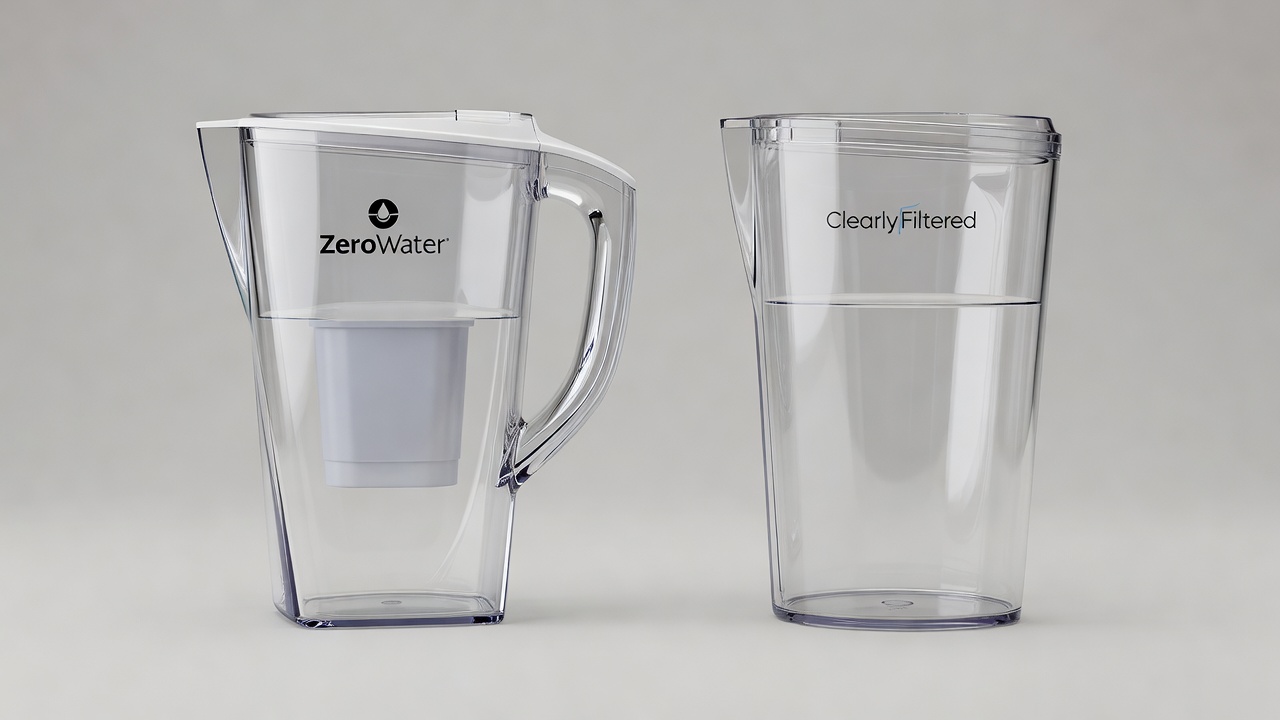
If you're shopping for a pitcher that removes PFAS (forever chemicals), you're choosing between two proven systems: ZeroWater and Clearly Filtered. Both claim to reduce PFAS. Both have lab data. But they filter in completely different ways and the long-term cost difference is significant.
This guide breaks down PFAS removal performance, TDS reduction, filter lifespan, cost per gallon, and which pitcher makes sense for city water vs well water contamination.
Quick Specs Comparison
| Feature | ZeroWater | Clearly Filtered |
|---|---|---|
| PFAS Removal | Yes (NSF 401 certified for select PFAS) | Yes (95-99.5%+ across 9 PFAS compounds tested) |
| TDS Removal | 100% (reduces TDS to 0 ppm) | Not a TDS reducer (retains beneficial minerals) |
| Total Contaminants Targeted | ~25 (focus on TDS and heavy metals) | 365+ (including fluoride, lead, herbicides, pharmaceuticals) |
| Filter Lifespan | 15-40 gallons (highly variable by TDS) | 100 gallons per filter |
| Cost Per Filter | ~$15-18 | ~$60 (single), ~$50 in 3-pack |
| Cost Per Gallon | $0.38-$1.00+ (depends on source TDS) | $0.50-$0.60 |
| Taste | Ultra-pure (some report flat taste) | Clean with minerals retained |
| Pitcher Capacity | 10-12 cup models common | 10-cup pitcher |
| Included TDS Meter | Yes | No |
| Best For | High-TDS tap water, verifiable zero TDS | PFAS, fluoride, broad contaminant coverage |
How Each System Filters Water
ZeroWater: Five-Stage Ion Exchange
ZeroWater uses a five-stage ion exchange filtration system designed to reduce total dissolved solids (TDS) to zero. The stages include:
- Coarse filter screen: Removes sediment and particles
- Foam distributor: Disperses water evenly across the filter
- Multi-layer carbon and oxidation reduction alloy: Reduces chlorine and organic contaminants
- Ion exchange resin: Removes dissolved solids (minerals, metals, salts)
- Ultra-fine screen and non-woven membrane layers: Final particle capture
The ion exchange resin is the core of ZeroWater's performance. It strips out dissolved minerals, heavy metals, and many organic compounds, reducing TDS to 0 ppm. This is verifiable with the included TDS meter.
Clearly Filtered: Affinity Filtration Technology
Clearly Filtered uses a proprietary composite filtration system called Affinity Filtration Technology. It combines:
- Woven sediment filter screen: Removes particles and debris
- Granular activated carbon (GAC): Adsorbs chlorine, VOCs, and organic chemicals
- Ion exchange resin layer: Targets heavy metals, fluoride, and specific contaminants
- Proprietary composite media: Designed to reduce PFAS, pharmaceuticals, herbicides, and other trace contaminants
Unlike ZeroWater, Clearly Filtered does NOT remove all dissolved solids. It targets harmful contaminants while leaving beneficial minerals like calcium and magnesium in the water. This results in water that tastes more natural and retains some TDS.
PFAS Removal Performance: Lab Data
ZeroWater PFAS Claims
ZeroWater is NSF 401 certified for the reduction of select PFAS compounds, including PFOA and PFOS. However, NSF 401 certification covers a limited set of emerging contaminants, not the full spectrum of PFAS compounds found in drinking water.
In CNET's 2025 testing, ZeroWater reduced TDS from an average of 57 ppm down to 0 ppm. This confirms its ion exchange system works as advertised. However, TDS reduction is NOT the same as PFAS removal. Many PFAS compounds are not measured by a TDS meter because they don't contribute significantly to total dissolved solids.
Key point: ZeroWater removes PFAS, but the extent depends on the specific PFAS compound and the filter's remaining capacity. As the ion exchange resin saturates, PFAS removal efficiency drops.
Clearly Filtered PFAS Claims
Clearly Filtered provides third-party lab test results showing reduction rates for nine specific PFAS compounds ranging from 95.00% to 99.50%+. These include PFOA, PFOS, and other long-chain and short-chain PFAS variants.
According to the company's public performance data sheet, tested reduction rates include:
- PFOA: >99.5%
- PFOS: >99.5%
- PFNA: >98.0%
- PFHxS: >97.5%
- GenX: >95.0%
Clearly Filtered also targets over 365 contaminants, including fluoride (>99.54%), chlorine (>99.52%), lead (99.34%), arsenic (98.00%), uranium (96.67%), glyphosate, atrazine, and dozens of pharmaceuticals and pesticides. Reduction rates are based on testing at 100-gallon filter lifespan, not end-of-life performance.
Filter Lifespan and Real-World Durability
ZeroWater: Highly Variable
ZeroWater filters last 15 to 40 gallons depending on your source water's TDS level. If your tap water has a TDS of 150 ppm or higher, expect the low end of that range. The included TDS meter helps you track when the filter is exhausted.
When the filtered water TDS rises above 6 ppm, ZeroWater recommends replacing the filter. If you continue to use an exhausted filter, contaminant removal drops significantly and you may experience a fishy or sour taste due to ion exchange resin exhaustion.
User reports on Reddit and Amazon reviews consistently mention short filter life as the biggest drawback. For families using 1-2 gallons of filtered water per day, a ZeroWater filter may last 1-3 weeks. Cost adds up quickly.
Clearly Filtered: 100 Gallons Rated
Clearly Filtered rates its filters for 100 gallons, which is 2.5x to 6x longer than ZeroWater depending on your TDS. For a household using 1 gallon per day, that's roughly 3 months per filter.
The longer lifespan is possible because Clearly Filtered does not remove all TDS. It targets specific contaminants rather than stripping out every dissolved solid. This selective filtration approach extends the media's working capacity.
Customer feedback on lifespan is positive, with most users reporting the 100-gallon rating is accurate for moderate TDS tap water. Flow rate slows slightly toward the end of filter life, which is a natural indicator that replacement is due.
Cost Per Gallon: Real Numbers
| Scenario | ZeroWater Cost Per Gallon | Clearly Filtered Cost Per Gallon |
|---|---|---|
| Low TDS tap water (50-100 ppm) | $0.38-$0.50 (40 gallons per filter) | $0.50-$0.60 (100 gallons per filter) |
| Medium TDS tap water (150-250 ppm) | $0.60-$1.00 (15-25 gallons per filter) | $0.50-$0.60 (100 gallons per filter) |
| High TDS tap water (300+ ppm) | $1.00-$1.50 (10-15 gallons per filter) | $0.50-$0.60 (100 gallons per filter) |
For low-TDS city water (under 100 ppm), ZeroWater and Clearly Filtered cost roughly the same per gallon. For moderate to high TDS water, Clearly Filtered becomes significantly cheaper over time.
Taste Comparison: Zero TDS vs Mineral Water
ZeroWater: Ultra-Pure, Flat Taste
Because ZeroWater removes 100% of TDS, the resulting water has no mineral content. Some users describe this as "pure" or "clean." Others describe it as "flat" or "tasteless."
If you're used to bottled water brands like Dasani or Aquafina (which also use reverse osmosis or distillation to remove minerals), you'll likely prefer ZeroWater's taste. If you prefer spring water or mineral water, you may find ZeroWater's output bland.
Clearly Filtered: Natural Mineral Taste
Clearly Filtered retains calcium, magnesium, and other beneficial minerals while removing harmful contaminants. The result tastes more like natural spring water.
User reviews consistently mention improved taste compared to unfiltered tap water, but not the "sterile" profile of zero-TDS water. If you want filtered water that still tastes like water (with a hint of minerality), Clearly Filtered delivers that.
What They Don't Remove (And Why It Matters)
ZeroWater Limitations
- Does NOT remove bacteria or viruses: ZeroWater is not microbiologically rated. Do not use on untreated well water or surface water without boiling first.
- May remove beneficial minerals: Calcium and magnesium are stripped out along with contaminants. Long-term consumption of zero-mineral water is debated in nutrition circles.
- Short lifespan with high TDS: If your tap water has a TDS above 200 ppm, ZeroWater filters exhaust quickly and can develop off-tastes before you realize the filter is spent.
Clearly Filtered Limitations
- Does NOT reduce TDS to zero: If you're aiming for ultra-pure water for specific medical or industrial use, Clearly Filtered won't get you there.
- No included TDS meter: You can't verify filter performance as easily as with ZeroWater's included meter.
- Higher upfront filter cost: At $60 per filter (or ~$50 in a 3-pack), the initial investment is steeper than ZeroWater's $15-18 per filter.
Which Pitcher for Well Water?
For well water, Clearly Filtered is the better choice if your primary concerns are PFAS, nitrates, fluoride, arsenic, or uranium. Its broader contaminant coverage and longer lifespan make it cost-effective for well water with moderate TDS and diverse contamination risks.
Do NOT use either pitcher as your sole filtration if your well water is untreated or contains bacteria, viruses, or high levels of iron/manganese. Both systems lack microbiological filtration. For wells with bacterial contamination, UV sterilization or a whole-house RO system is required before point-of-use filtration.
If your well water has TDS above 300 ppm, ZeroWater may exhaust filters in under two weeks. That makes it impractical for regular use. Clearly Filtered handles moderate TDS better because it doesn't remove all dissolved solids.
Which Pitcher for City Water?
For city water treated with chlorine or chloramines, both pitchers work well. Your choice depends on priorities:
- Choose ZeroWater if: You want verifiable zero TDS, you're comfortable replacing filters every 2-4 weeks, and you prefer ultra-pure water taste.
- Choose Clearly Filtered if: Your priority is PFAS removal across a broad spectrum, you want longer filter life (100 gallons), and you prefer water that tastes like spring water with retained minerals.
For PFAS-contaminated city water, Clearly Filtered's third-party lab data for nine specific PFAS compounds gives it an edge. ZeroWater's NSF 401 certification covers fewer PFAS variants.
NSF Certifications: What They Mean
ZeroWater
ZeroWater is certified to:
- NSF/ANSI 42: Aesthetic effects (chlorine, taste, odor)
- NSF/ANSI 53: Health effects (lead, mercury, chromium)
- NSF/ANSI 401: Emerging contaminants (select PFAS, pharmaceuticals)
NSF 401 is relatively new and covers a limited set of contaminants. Not all PFAS compounds are included in the standard, so "NSF 401 certified" does not mean "removes all PFAS."
Clearly Filtered
Clearly Filtered does NOT carry NSF certification for the filter itself. Instead, the company publishes third-party lab test results for 365+ contaminants, including 9 PFAS compounds. These tests are conducted at independent labs and updated periodically.
The lack of NSF certification is a common point of confusion. NSF certification is expensive and time-consuming for manufacturers. Many high-performing filters rely on third-party lab testing instead. Clearly Filtered's public performance data sheet is more comprehensive than what NSF standards require, but it doesn't carry the NSF mark.
Real Customer Complaints (Analyzed)
ZeroWater
Most common complaints:
- Short filter life: Filters last 1-3 weeks for families with moderate tap water TDS. Replacement costs add up.
- Fishy or sour taste when exhausted: When the ion exchange resin is spent, water can develop an off-taste even if TDS reads low. This happens when the resin begins releasing captured contaminants.
- Slow flow rate: Filtration takes 10-15 minutes for a full pitcher. Some users find this inconvenient compared to faster carbon-only pitchers.
Positive feedback: Users love the included TDS meter and the verifiable zero-TDS output. For those who want proof their water is pure, ZeroWater delivers that confidence.
Clearly Filtered
Most common complaints:
- High filter cost: At $60 per filter, the upfront cost is a barrier. Bulk packs reduce cost to ~$50 per filter, but that still requires a larger initial investment.
- Slow initial prime: The first fill of a new filter requires a longer soak and prime time. Some users report 15-20 minutes for the first batch.
- No TDS meter included: Unlike ZeroWater, there's no easy way to verify filter performance at home.
Positive feedback: Users consistently praise the taste (clean but not flat), the long filter life (100 gallons as advertised), and confidence in PFAS removal based on published lab data.
Recommendations by Use Case
| Use Case | Recommended Pitcher | Why |
|---|---|---|
| City water with known PFAS contamination | Clearly Filtered | Broader PFAS coverage, longer filter life, cost-effective |
| High-TDS tap water (>200 ppm) | Clearly Filtered | ZeroWater filters exhaust too quickly, cost per gallon too high |
| Low-TDS city water, want verifiable zero TDS | ZeroWater | TDS meter included, ultra-pure output, comparable cost |
| Well water with fluoride, nitrates, or arsenic | Clearly Filtered | Removes fluoride and heavy metals, longer lifespan |
| Renter in apartment, need quick setup | ZeroWater | No priming wait, included TDS meter for verification |
| Family of 4+, high daily usage | Clearly Filtered | 100-gallon lifespan reduces filter change frequency |
| Prefer spring water taste | Clearly Filtered | Retains beneficial minerals for natural flavor |
| Prefer ultra-pure distilled taste | ZeroWater | Zero TDS produces flat, pure water profile |
Where to Buy
Both pitchers are available on Amazon:
- Clearly Filtered No. 1 Filtered Water Pitcher (10-cup): Check current price on Amazon
- Clearly Filtered Water Pitcher Replacement Filter (Single): Check current price on Amazon
- Clearly Filtered 3-Pack Replacement Filters: Check current price on Amazon
- ZeroWater 10-Cup Ready-Pour Pitcher: Check current price on Amazon
Both brands also sell directly from their websites. Clearly Filtered often runs promotions for filter subscriptions, which can reduce per-filter cost further.
Final Verdict
If your primary goal is PFAS removal and you want a filter that lasts longer than a few weeks, Clearly Filtered is the better long-term investment. Its 100-gallon lifespan and comprehensive contaminant coverage make it cost-effective for families and high-usage households.
If you have low-TDS city water, want verifiable zero-TDS output, and don't mind changing filters every 2-4 weeks, ZeroWater delivers ultra-pure water at a comparable cost per gallon. The included TDS meter is a major convenience.
For well water with unknown contamination, neither pitcher is sufficient on its own. Test your well water first (TDS, bacteria, nitrates, arsenic, uranium). If bacterial contamination is present, install UV sterilization or a whole-house system before using any pitcher filter.
Photos provided by Pexels.