ZeroWater vs Brita Elite: PFAS, Lead, and TDS Compared
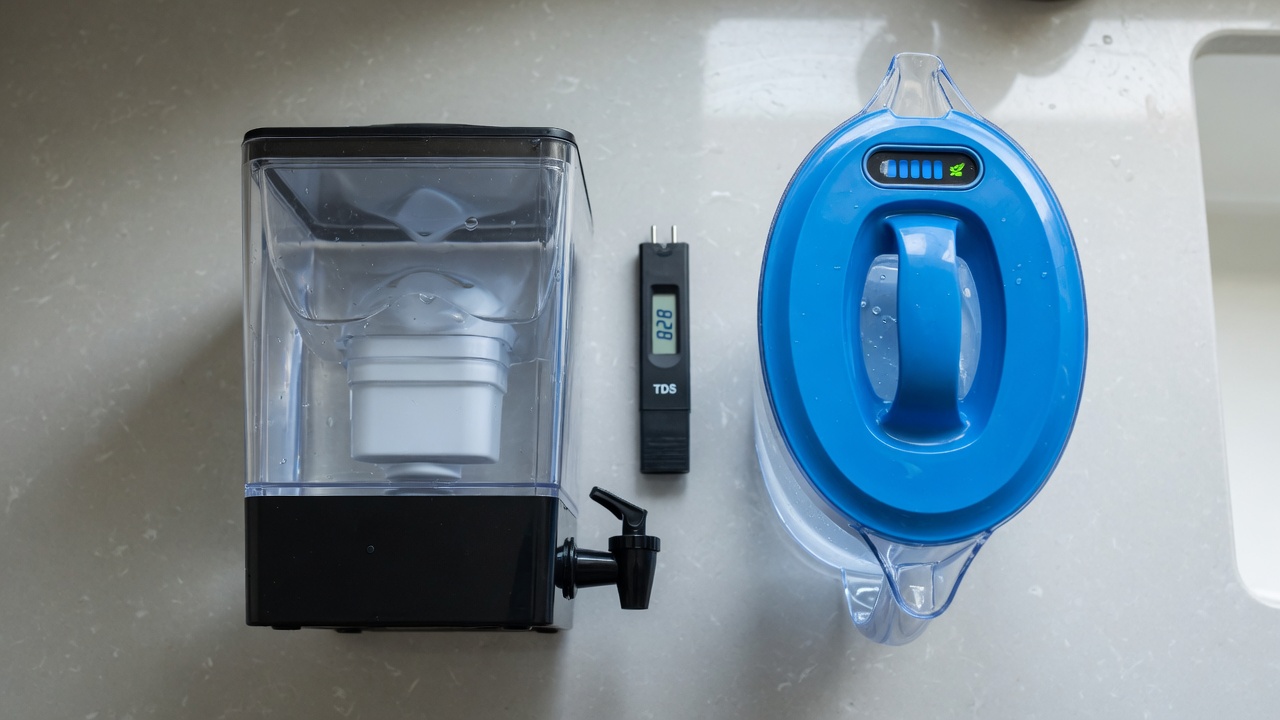
ZeroWater and Brita Elite sit in roughly the same price range and target the same buyer: someone who wants better water than the tap delivers and is willing to spend $30-40 on a pitcher to get there. The technology each uses, the contaminants each targets, and the cost over twelve months are completely different.
ZeroWater uses a 5-stage ion exchange system that removes essentially everything dissolved in water, including TDS, heavy metals, and PFAS as a side effect. Brita Elite uses activated carbon with ion exchange resin that targets a defined contaminant list: lead, chlorine, PFOA, PFOS, and a small set of pharmaceuticals.
This guide breaks down which pitcher actually wins on PFAS, on lead, on TDS, and on long-term cost based on independent third-party testing data.
Quick Specs Comparison
| Feature | ZeroWater | Brita Elite |
|---|---|---|
| PFAS Removal (EWG independent test) | ~100% (ion exchange removes everything) | 22% (real-world) |
| Lead Removal | 99%+ (NSF 53 certified) | 99% (NSF 53 certified, IAPMO R&T) |
| TDS Reduction | ~100% | Minimal (not designed for TDS) |
| Filter Lifespan (varies by TDS) | 15-40 gallons (TDS dependent) | 120 gallons (6 months) |
| Cost Per Filter | ~$12-15 | ~$15-18 |
| Cost Per Gallon (low TDS) | ~$0.30 | ~$0.15 |
| Cost Per Gallon (high TDS) | ~$1.00-1.20 | ~$0.15 |
| TDS Meter Included | Yes (verify filter performance) | No |
| Pitcher Capacity | 10 cups (with Ready-Pour) | 10 cups |
| NSF Certifications | 42, 53, 401, P473 | 42, 53, 401 (PFOA/PFOS only) |
| Best For | High TDS, PFAS, all-in-one removal | Budget buyers, basic lead and chlorine |
How Each Filter Works
ZeroWater: 5-Stage Ion Exchange
ZeroWater is the only mainstream pitcher that uses true ion exchange resin as its primary filtration mechanism. Tap water passes through five stages: a coarse sediment screen, foam distributor, multi-layer activated carbon and oxidation reduction alloy, ion exchange resin bed, and a fine sediment screen.
The ion exchange resin removes dissolved solids by swapping out unwanted ions for hydrogen and hydroxyl ions, which combine to form additional water. The result is water with essentially zero total dissolved solids, which is why ZeroWater includes a TDS meter to verify performance and tell you when to replace the filter.
The side effect of ion exchange: anything dissolved in the water comes out. This is why ZeroWater achieves near-100% PFAS reduction in independent testing without being specifically engineered for PFAS. It also removes beneficial minerals like calcium and magnesium, which affects taste.
Brita Elite: Activated Carbon Plus Ion Exchange
The Brita Elite filter (model OB06) uses denser activated carbon than the standard Brita filter, paired with ion exchange resin specifically targeted at lead. Water flows through the carbon bed and ion exchange resin, with the carbon binding chlorine, PFOA, PFOS, and select organic compounds, and the ion exchange resin binding lead.
This design targets a defined contaminant list rather than reducing everything dissolved. Minerals pass through largely intact, which keeps the water tasting closer to standard tap water. The trade-off is that the filter does not address contaminants outside its target list, including TDS, fluoride, or the broader PFAS family beyond PFOA and PFOS.
PFAS: The Test Most Buyers Don't Know About
NSF 53 certification for PFOA and PFOS sounds reassuring, but it covers two specific compounds out of more than 12,000 known PFAS chemicals. Independent third-party testing by the Environmental Working Group looked at total PFAS removal in real tap water conditions, not just the certified compounds.
Results:
- ZeroWater: Near 100% total PFAS reduction. Ion exchange removes essentially everything dissolved including the broader PFAS family.
- Brita Elite: 22% total PFAS reduction. Lowest in the panel. Activated carbon binds PFOA and PFOS but does not effectively bind shorter-chain PFAS compounds.
If PFAS contamination is a known concern in your municipal water supply or your private well, the gap between these two pitchers is dramatic. Brita Elite's certification claim covers two compounds. ZeroWater removes the rest as a side effect of doing what it does for TDS.
If you need both certified PFAS reduction and broader contaminant coverage at the same level, neither pitcher is the strongest single answer. See our ZeroWater vs Clearly Filtered comparison for the head-to-head on the two pitchers with the strongest combined PFAS and contaminant coverage.
Lead: Both Are Genuinely Good
Lead is one area where both pitchers deliver. Brita Elite carries NSF 53 lead certification with documented 99%+ reduction in lab testing. ZeroWater similarly removes lead through ion exchange, also at 99%+ levels.
For households concerned only about lead (older home with pre-1986 copper plumbing and solder joints, or a building on the EPA lead service line list), either pitcher works. The choice comes down to other factors like cost, taste preference, and filter life.
TDS: The Hidden Cost Driver
ZeroWater's biggest selling point is also its biggest hidden cost. The included TDS meter shows your tap water's dissolved solids count, and the filter is rated to deliver water below 6 ppm. When the output crosses 6 ppm, the filter is exhausted.
How fast that happens depends entirely on your tap water:
- Tap water at 50 ppm TDS (soft water, common in upper Midwest and Pacific Northwest): ZeroWater filter lasts 25-40 gallons.
- Tap water at 200 ppm TDS (moderate, common in much of the US): ZeroWater filter lasts 15-20 gallons.
- Tap water at 400 ppm TDS (hard water, common in the Southwest and Texas): ZeroWater filter lasts 8-12 gallons.
- Tap water at 600+ ppm TDS (very hard, parts of Arizona, Nevada, California): ZeroWater filter lasts under 8 gallons.
This is why the cost per gallon column in the spec table has two rows for ZeroWater. The same $12-15 filter delivers very different per-gallon economics depending on your zip code. Brita Elite does not have this problem because its lifespan is set by carbon saturation, not TDS exhaustion.
Check your local water utility's annual Consumer Confidence Report for your average TDS, or measure it directly with any cheap TDS meter, before assuming ZeroWater is the cheaper option.
Cost Per Gallon Over 12 Months
Three scenarios for a household of four using one pitcher per day, roughly 50 gallons per month:
| Scenario | ZeroWater Year 1 | Brita Elite Year 1 |
|---|---|---|
| Low TDS area (under 100 ppm) | ~$220 (pitcher + 18 filters) | ~$71 (pitcher + 2 filters) |
| Medium TDS area (200 ppm) | ~$370 (pitcher + 33 filters) | ~$71 |
| High TDS area (400+ ppm) | ~$700+ (pitcher + 60+ filters) | ~$71 |
The cost difference is not subtle. ZeroWater can run three to ten times more expensive than Brita Elite over a year, depending entirely on your local water hardness. The TDS meter is genuinely useful for monitoring filter life, but it also makes the ongoing cost visible in a way Brita Elite hides.
Real Customer Complaints (Analyzed)
ZeroWater
- Filters die fast in hard water: Users in Arizona, Texas, and California report 7-14 day filter life on heavy use. This is not a defect, it is the filter doing exactly what it is designed to do in high-TDS water.
- Sulfur smell from exhausted filters: A small percentage of users report a rotten egg smell when filters are nearing exhaustion. This is sulfur-reducing bacteria activity in the spent ion exchange resin. Replace the filter immediately when this happens.
- Flat taste: Removing all minerals leaves water tasting distilled. Some users find this clean and refreshing. Others find it sterile.
Positive feedback: Verifiable filtration via TDS meter, near-complete contaminant removal for emergency or unknown-water situations, NSF 401 certification for emerging contaminants.
Brita Elite
- Slow flow rate: Denser carbon means slower filtration than standard Brita filters. Common surprise for upgrading users.
- Filter indicator unreliable: Electronic indicator counts time, not gallons. Heavy users exceed the 120-gallon rating before 6 months and the indicator does not warn them.
- Confusion with Standard filters: Brita sells multiple filter types in similar packaging. Buyers regularly think they bought Elite filters and got Standard, losing the lead and PFOA/PFOS protection.
Positive feedback: Reliable lead reduction, low cost per gallon regardless of water hardness, easy filter availability at any grocery store.
Recommendations by Use Case
| Use Case | Recommended Pitcher | Why |
|---|---|---|
| City water, low TDS, basic chlorine and lead reduction | Brita Elite | Lower cost per gallon, longer filter life, taste closer to tap |
| Known PFAS contamination in water supply | ZeroWater | ~100% PFAS reduction vs Brita's 22% in independent testing |
| High TDS area (Southwest, hard water) | Brita Elite OR look at Clearly Filtered | ZeroWater filter life crashes in hard water, making it very expensive |
| Want verifiable filtration via TDS meter | ZeroWater | Brita Elite has no output measurement |
| Emergency preparedness or unknown water | ZeroWater | Removes essentially everything dissolved including unknowns |
| Lowest annual cost priority | Brita Elite | $71/year vs ZeroWater's $220-700+/year depending on TDS |
| Want to keep mineral taste | Brita Elite | Leaves calcium and magnesium; closer to natural water taste |
| Need both PFAS AND broad contaminant coverage | Neither pitcher; consider Clearly Filtered | ZeroWater removes everything but filter life is brutal in hard water; Brita Elite misses PFAS broadly |
Where to Buy
Both pitchers are available on Amazon:
- ZeroWater 10-Cup Ready-Pour Pitcher: Check current price on Amazon
- Brita 10-Cup Everyday Pitcher with Elite Filter: Check current price on Amazon
- Clearly Filtered No. 1 Pitcher (premium alternative): Check current price on Amazon
Both ZeroWater and Brita Elite are widely available at Target, Walmart, Costco, and grocery stores. ZeroWater replacement filters are often cheaper in 4-packs or 8-packs.
Final Verdict
For most municipal water in low to moderate TDS areas with the standard concern set of chlorine taste and lead reduction, Brita Elite is the practical choice. Lower cost per gallon, longer filter life, easier filter availability.
For households with known PFAS contamination or who want verifiable comprehensive filtration via the TDS meter, ZeroWater is the right answer despite the higher cost per gallon. The ion exchange technology removes everything dissolved, including the broader PFAS family that Brita Elite's certification does not address.
If you live in a high-TDS area (over 300 ppm), neither pitcher is ideal. ZeroWater filter life crashes to 8-15 gallons making it expensive, and Brita Elite does not address TDS at all. In that case, look at Clearly Filtered for broad contaminant coverage including PFAS without the TDS-dependent cost issue.
For comparison shoppers weighing Clearly Filtered against ZeroWater specifically (the two pitchers that actually remove PFAS in independent testing), see our ZeroWater vs Clearly Filtered comparison for the head-to-head.
The cheapest pitcher that solves your specific water problem is always the right pitcher. Test your tap water TDS and PFAS levels first, then match the pitcher to the actual problem rather than the marketing pitch.
Photos provided by Pexels.