Affiliate Disclosure: WaterFilterGeek is reader-supported. When you buy through links on our site, we may earn a small commission at no extra cost to you. This never influences our recommendations. Affiliate ID: mindshift061-20.
WaterCheck Test Kit (Pro Lab Analysis)
Most comprehensive: tests for 100+ contaminants including bacteria, with professional lab analysis included.
PRO Lab Water Test Kit
Best value comprehensive test. Covers bacteria, minerals, chemicals, and metals in one affordable package.
AquaVial Water Test Strips
Best quick DIY test. Instant results for hardness, pH, chlorine, and bacteria in under 5 minutes.
You cannot treat what you cannot see. Whether you rely on well water, city water, or a private system, knowing what contaminants are present is the essential first step to protecting your family. Home water testing kits range from $15 strips that give you basic pH readings to $200+ professional lab tests that screen for 100+ contaminants including bacteria, nitrates, heavy metals, and PFOA forever chemicals. This guide cuts through the noise and matches the right test to your actual water situation.
DIY vs Lab Testing: Which Do You Need?
Water testing falls into two categories, and your choice depends on your water source and the level of certainty you need.
Instant results at home for pH, chlorine, hardness, bacteria, nitrates. Cost $15-$50. Limitations: less accurate for heavy metals, cannot detect all bacteria types or chemical contaminants like PFOA.
You collect samples at home and mail to certified lab. 5-14 day turnaround. Tests for 50-100+ contaminants including bacteria culture, metals, pesticides, PFOA. Cost $100-$300.
If you have a private well, annual professional testing is essential. Most critical for bacteria, nitrates, arsenic, and uranium. EPA does not regulate private wells. Cost varies by lab.
City water is regulated and tested by your municipal utility. Request a water quality report (CCR - Consumer Confidence Report). If you suspect problems, DIY or lab testing confirms what's in your specific line.
Already installed a system? Test afterward to verify your filter is performing. Test strips confirm chlorine removal, lab tests verify heavy metal and bacteria reduction.
Wells degrade over time. Plan for annual testing (especially bacteria and nitrates). City water quality can shift with infrastructure changes or algal blooms.
Home Water Test Kit Comparison
| Product | Type | Price | Contaminants Tested | Best For |
|---|---|---|---|---|
| WaterCheck Pro Kit | Lab Analysis | $149-$199 | 100+ (bacteria, metals, chemicals, PFOA) | Comprehensive baseline, well water |
| PRO Lab Test Kit | Lab Analysis | $99-$149 | 80+ (bacteria, nitrates, metals, minerals) | Value comprehensive test |
| AquaVial Test Strips | DIY Instant | $15-$35 | 7 (pH, chlorine, hardness, bacteria indicator) | Quick screening, renters, basic checks |
| LaMotte WaterLink | Digital DIY | $200-$400 | 15+ (advanced on-site analysis) | Frequent testing, professionals, pools |
| API Master Test Kit | DIY Liquid | $25-$45 | 6 (ammonia, nitrite, nitrate, pH, hardness) | Aquariums and home systems, simple results |
WaterCheck Home Water Test Kit (Pro Lab Analysis)
WaterCheck is the gold standard for comprehensive home testing. You collect a simple water sample in a sterile bottle provided in the kit, mail it to their certified lab, and receive a detailed report 7-10 days later analyzing over 100 contaminants including bacteria, heavy metals, nitrates, PFOA forever chemicals, pesticides, and minerals. The report includes treatment recommendations based on EPA drinking water standards. Trusted by well owners, realtors, and homebuyers nationwide.
- Contaminants Tested: 100+
- Key Tests: Bacteria, nitrates, arsenic, lead, PFOA, pesticides, minerals
- Turnaround Time: 7-10 business days
- Report Format: Detailed PDF with treatment recommendations
- Cost: $149-$199
- Lab Certification: EPA-certified, ISO 17025 accredited
Pros
- Most comprehensive contaminant screening available
- Certified EPA lab analysis, not DIY guesswork
- Tests for PFOA and modern forever chemicals
- Detailed report with actionable treatment guidance
- Trusted by professionals, realtors, and well owners
Cons
- Higher upfront cost ($150-$200)
- 7-10 day wait for results (not instant)
- Requires proper sample collection technique
Our Verdict
WaterCheck is the right choice if you have a private well, are buying a home with well water, or suspect heavy contamination. The cost is worth it for peace of mind and a professional lab analysis you can trust. Start with WaterCheck, then choose your filter based on the actual results.
PRO Lab Complete Water Test Kit
PRO Lab offers the most affordable comprehensive lab testing option. Like WaterCheck, you collect a sample and mail it for analysis, but PRO Lab screens for 80+ contaminants at a lower price point. Covers bacteria, nitrates, arsenic, lead, iron, manganese, hardness, and other key minerals and metals. Turnaround is 5-7 business days. Great for well owners on a budget who still want professional lab accuracy.
- Contaminants Tested: 80+
- Key Tests: Bacteria, nitrates, arsenic, lead, iron, hardness
- Turnaround Time: 5-7 business days
- Report Format: Detailed PDF with standards comparison
- Cost: $99-$149
- Lab Certification: ISO 17025 accredited
Pros
- More affordable than WaterCheck ($100 vs $150+)
- Still comprehensive coverage of major contaminants
- Faster turnaround (5-7 days)
- Professional lab certification
- Excellent for well water baseline testing
Cons
- Does not screen for PFOA and newer forever chemicals
- Slightly less detail in pesticide screening
- Still requires waiting for results
Our Verdict
PRO Lab is the best value if you need comprehensive lab testing without the premium price. It covers the essentials for well water and city water quality verification. If you are in a PFOA-contaminated area or near industrial sites, upgrade to WaterCheck for the fuller chemical panel.
AquaVial Complete Water Test Strips
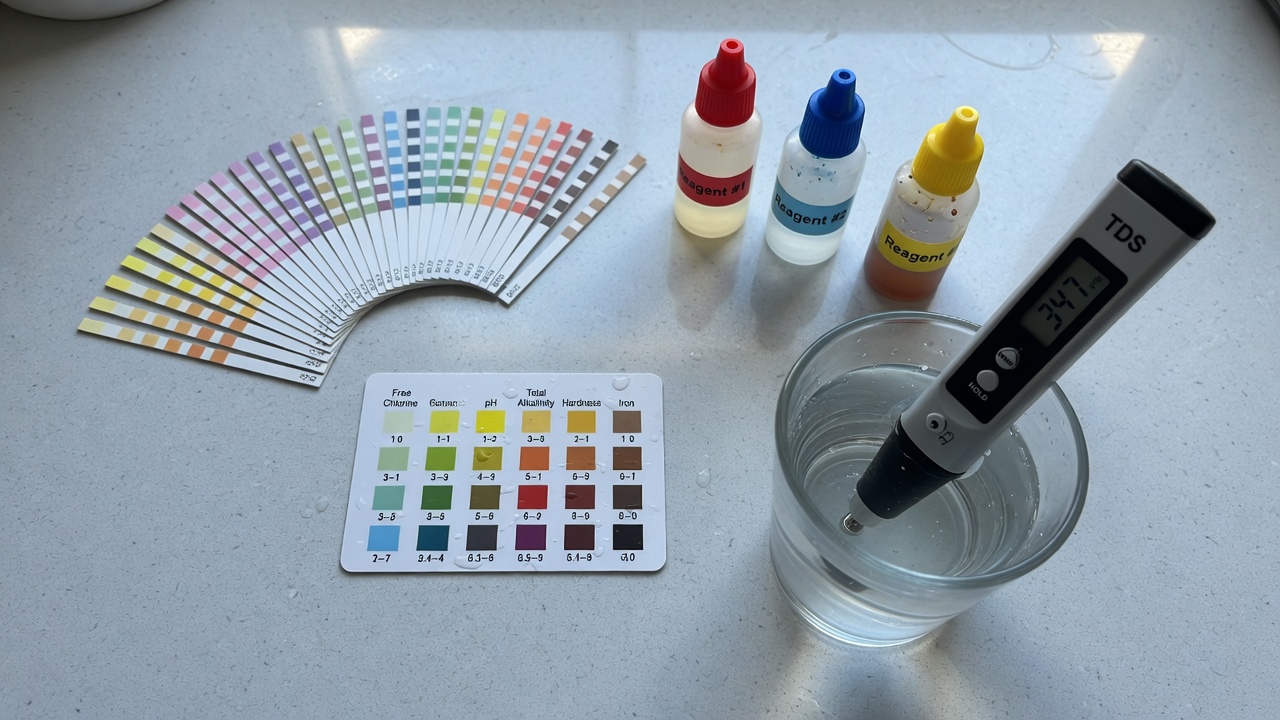
AquaVial test strips deliver instant results for the essentials: pH, chlorine, hardness, nitrates, and bacterial contamination (coliform indicator). Dip a strip in water, compare to the color chart in 30-60 seconds, and know if you have basic problems. Each box includes 50 strips, making them ideal for monitoring over time or testing multiple water sources. Perfect for renters, quick baseline checks, or after filter installation confirmation.
- Contaminants Tested: 7 (pH, chlorine, hardness, nitrate, bacteria, alkalinity, fluoride)
- Results Speed: Instant (30-60 seconds)
- Accuracy: Good for home screening, not lab-grade
- Strips Per Box: 50 strips
- Cost: $15-$35
- Storage: Lasts 2 years unopened
Pros
- Instant results at home, no waiting
- Very affordable ($20-30 per kit)
- 50 strips per box - test multiple locations
- Renter-friendly, no installation needed
- Quick way to monitor filter effectiveness
Cons
- Not as accurate as professional lab analysis
- Cannot detect heavy metals or complex contaminants
- Color matching is subjective and can be inconsistent
- Bacterial test is an indicator only, not a culture
Our Verdict
AquaVial strips are excellent for quick baseline checks and monitoring over time, but they are not a substitute for professional lab testing. Use them to screen before you buy a filter, then follow up with a professional lab kit (like WaterCheck or PRO Lab) if you detect problems. Think of them as a fast early warning system, not a final diagnosis.
LaMotte WaterLink Digital Water Analyzer
For serious DIY testers, the LaMotte WaterLink is a digital photometer that tests 15+ water parameters at home without mailing samples away. It uses test reagents and digital color analysis for more accurate readings than paper strips. Designed for pools, hot tubs, and drinking water systems. Results display on a digital screen within minutes. Reagent bottles last dozens of tests, though they add ongoing cost. Premium option for homeowners who test frequently or manage multiple water systems.
- Contaminants Tested: 15+ (pH, alkalinity, hardness, chlorine, iron, nitrate, turbidity, and more)
- Results Speed: 2-5 minutes per test
- Accuracy: Better than strips, approaching basic lab-grade
- Display: Digital color analyzer with touchscreen
- Initial Cost: $200-$400
- Ongoing Cost: Reagent bottles $20-50/set (lasts 20-40 tests)
Pros
- More accurate than paper strips, nearly lab-grade
- Digital readout eliminates color-matching guesswork
- Tests multiple parameters in one kit
- Ideal for people who test frequently
- No mailing samples, immediate results
Cons
- High upfront cost ($200-$400)
- Reagents are an ongoing expense
- Requires calibration and maintenance
- Overkill for occasional testing
- Still cannot detect all heavy metals or PFOA
Our Verdict
The LaMotte WaterLink is best for homeowners managing wells, multiple properties, or pool systems who need frequent testing without lab turnaround. The upfront cost is high, but if you plan to test quarterly or annually, it pays for itself quickly compared to buying multiple lab kits. Pair it with a professional lab test every 2-3 years for heavy metal confirmation.
API Master Test Kit (Liquid Chemistry)
The API Master Test Kit uses liquid chemistry reagents instead of paper strips for more precise DIY testing. Originally designed for aquarium water, it works equally well for tap water and well water testing. Tests ammonia, nitrite, nitrate, pH, general hardness, and alkalinity. Results are fast and repeatable with practice. Very affordable at $25-$45. A solid choice for budget-conscious DIYers who want more accuracy than strips but cannot justify lab test costs.
- Contaminants Tested: 6 (ammonia, nitrite, nitrate, pH, hardness, alkalinity)
- Results Speed: 5-10 minutes per test
- Method: Liquid reagent chemistry (high school lab style)
- Accuracy: Better than strips with practice, good for monitoring
- Cost: $25-$45
- Reagent Life: Lasts 500-600 tests per kit
Pros
- Very affordable ($30)
- More accurate than paper strips
- Long reagent life (500+ tests per kit)
- Large test volume per kit makes cost per test low
- Widely trusted brand (aquarium standard)
Cons
- Limited contaminants (6 basic parameters only)
- No heavy metals or pesticide testing
- Requires careful color matching and patience
- Takes longer than strips or digital analyzers
- Reagent bottles expire in storage
Our Verdict
API Master Kit is ideal for monitoring basic water quality if you already have professional baseline testing from a lab kit. Use it to track changes over time or verify that your filter is working. It is not comprehensive enough as a standalone diagnostic tool for well water, but as a low-cost monitoring solution, it cannot be beaten.
How to Choose the Right Water Test for Your Situation
Step 1: Identify Your Water Source
Private well water requires the most comprehensive testing. Wells are not regulated by the EPA and can contain bacteria, nitrates, heavy metals, and PFOA depending on geology and nearby land use. Start with a professional lab test like WaterCheck. City/municipal water is regulated and safer, but local quality varies. Request your water utility's annual Consumer Confidence Report (CCR) first, then supplement with DIY or lab testing if you detect issues. Renters who cannot access municipal reports should start with a basic DIY test.
Step 2: Know Your Real Risks
Location matters. Agricultural areas with frequent fertilizer use should test for nitrates. Mining regions and older industrial areas are higher risk for arsenic and heavy metals. Areas with septic systems need annual bacterial testing. Homes built before 1990 in lead-risk states should test for lead. Talk to neighbors with wells in your area about what they have found. This gives you real clues about what to screen for.
Step 3: Start with the Right Test Category
If you are a first-time well owner or buying a home with well water, start with a comprehensive lab test (WaterCheck or PRO Lab). The $100-$200 investment prevents costly mistakes. If you already know your water is relatively clean and want to monitor it periodically, DIY kits (AquaVial strips or API liquid tests) are fine. If you test multiple times per year, invest in a digital analyzer like the LaMotte WaterLink to amortize the upfront cost.
Step 4: Proper Sample Collection
Lab test results are only as good as the sample. Use the sterile bottles provided with your kit. Do not use old containers or bottles that held chemicals or soap. Collect samples from a cold water tap, not hot water. Run the tap for 2-3 minutes to purge stagnant water from the line before collecting. For wells, collect directly from the well tap or inside spigot closest to the wellhead if possible. Follow kit instructions precisely. Improper sampling leads to false results.
Step 5: Plan for Annual Retesting
Water quality changes over time. Wells can develop bacterial contamination from cap degradation or casing compromise. City water quality can shift with infrastructure changes or algal blooms. Schedule annual testing (or quarterly if you have known issues). Baseline results from a lab kit + annual DIY monitoring is a cost-effective approach for ongoing safety.
Understanding Common Contaminants and What Tests Detect Them
Not all tests detect all contaminants. Understanding what each test type can and cannot catch is critical to choosing the right one.
Bacterial Contamination
Total coliform and E. coli bacteria indicate fecal contamination from septic systems, surface water intrusion, or aged well casings. DIY test strips show a coliform indicator, but only a lab culture test confirms the specific bacteria and severity. If your DIY test or lab test shows positive bacteria, do not delay. Shock chlorinate your well immediately and retest after treatment. Annual bacterial testing is essential for wells.
Nitrates
Colorless, odorless, and tasteless, nitrates from agricultural fertilizer and septic systems are dangerous for infants and pregnant women. DIY tests like AquaVial strips can detect high nitrate levels, but professional lab tests are more accurate at lower ranges. If you are near farmland or septic systems, test annually. Lab testing is strongly recommended if you have infants in the home.
Heavy Metals: Arsenic and Lead
Arsenic occurs naturally in many aquifers. Lead comes from old plumbing and solder. Neither shows color, taste, or odor. DIY tests cannot detect these metals at meaningful levels. Professional lab testing (WaterCheck or PRO Lab) is essential if you have any risk factors: well in an arsenic-prone state (Southwest, upper Midwest), home built before 1990 in certain regions, or old plumbing. Single-metal test kits for lead exist ($20-$40) but are less accurate than comprehensive lab testing.
PFOA and Forever Chemicals
PFOA contamination is widespread near airports, fire departments, military bases, and manufacturers. It does not break down in the environment or human body, accumulating over time. Only comprehensive lab tests like WaterCheck screen for PFOA and related per- and polyfluoroalkyl substances (PFAS). If you are near any of these facilities or in a known PFOA hotspot, professional lab testing is not optional.
Chlorine and Chlorine Byproducts
Municipal water contains chlorine for disinfection. DIY strips detect free and total chlorine instantly. If you are on city water and taste/smell chlorine, this is normal. If you have installed a filter or softener, use DIY strips to confirm chlorine removal at the tap. Lab tests do not typically screen for chlorine since it is a known addition in treated water.
Hardness (Calcium and Magnesium)
Hard water causes scale buildup on fixtures, reduces soap effectiveness, and shortens appliance lifespan. DIY strips detect hardness instantly (measured in GPG, grains per gallon). Lab tests also report hardness. If your strip shows over 7 GPG, water softening is recommended. This is a key parameter for both DIY and lab tests.
After You Get Your Test Results: What to Do Next
You have your water test results. Now what?
Interpret Against EPA Standards
Professional lab reports show your results compared to EPA Maximum Contaminant Levels (MCLs) for drinking water. If any contaminant exceeds the MCL, you need treatment. The report usually includes treatment recommendations. Pay attention to those. Do not ignore results that are under the MCL but elevated for your region - some areas naturally have higher mineral content, and local guidance matters.
Prioritize Treatment
If you have multiple contaminants, treat in this order: (1) Bacteria first - always, using UV or chlorination. (2) Nitrates - critical if you have infants or are pregnant. (3) Heavy metals like arsenic and lead. (4) Aesthetic issues like iron, sulfur, and hardness that affect comfort but not health. Do not buy a filter until you have test results in hand. Match the filter to the specific contaminants found, not to a salesman's upsell.
Choose the Right Filter Technology
Results guide filter selection. Bacteria requires UV or chemical disinfection. Nitrates require reverse osmosis (activated carbon alone does not work). Iron and sulfur require oxidizing filters or aeration. Lead and other metals require carbon filters or RO. Hard water requires a softener. Many homes need multiple treatment stages in series. Your lab report will suggest the right approach.
Test After Installation
Once you install a filter system, test again to confirm it is working. Use DIY strips or a quick lab test to verify treatment effectiveness. If results show the filter is not performing, contact the manufacturer immediately. Defective filters should be replaced under warranty.
Schedule Regular Retesting
Do not test once and forget. Water quality changes. Plan for annual testing at minimum, especially for well water. Quarterly testing is ideal for wells with any history of contamination. Use affordable DIY tests to monitor between lab tests. This proactive approach catches problems early before they harm your family.
Frequently Asked Questions
How much does a home water test cost?
Do I need a water test if I am on city water?
How accurate are DIY test strips compared to lab testing?
Can I test water from a well tap versus at the kitchen faucet?
What should I do if my test shows bacterial contamination?
How often should I test my well water?
Can I use tap water testing kits to check pool or aquarium water?
Why Trust WaterFilterGeek?
Water testing is the foundation of every smart water treatment decision. We built this guide because homeowners deserve honest guidance on which tests actually work and which are worth your money. Testing kits range from useless to genuinely helpful. We call out the difference. No commissions influence our picks. Only accuracy and real-world results.
Bottom Line
You cannot choose the right filter until you know what you are treating. Start with a professional lab test (WaterCheck for the most comprehensive screening, PRO Lab for best value) if you have a well or any concerns about water quality. Use DIY tests like AquaVial strips for quick baseline checks and ongoing monitoring. Plan for annual retesting to catch changes early. Most importantly, test before you buy a filter. It is the difference between solving your actual problem and wasting thousands on a system that does not match your water.