
Affiliate Disclosure: WaterFilterGeek is reader-supported. When you buy through links on our site, we may earn a small commission at no extra cost to you. This never influences our recommendations -- we only suggest products we'd install in our own homes.
Waterdrop G3P800 Tankless RO
Best overall, NSF 42/53/58 certified, 800 GPD tankless RO with verified PFAS reduction.
Express Water 3-Stage Whole-House
Best whole-house option, heavy metal plus PFAS reduction for every tap and shower.
APEC ROES-50 Under-Sink RO
Best value RO system, proven 5-stage filtration with WQA certification for PFAS removal.
Clearly Filtered Water Pitcher
Best pitcher for PFAS, targets 365+ contaminants including PFOA, PFOS, and fluoride.
Express Water RO5DX Under-Sink RO
Best budget RO, 5-stage system with dedicated PFAS-rated carbon block filtration.
PFAS, short for per- and polyfluoroalkyl substances, are a group of more than 12,000 synthetic chemicals found in everything from non-stick cookware to firefighting foam. They are called "forever chemicals" because they do not break down in the environment or the human body. The EPA set Maximum Contaminant Levels for six PFAS compounds in April 2024, with enforceable limits as low as 4 parts per trillion for PFOA and PFOS. Most standard water filters do not remove PFAS. This guide focuses specifically on systems that are certified or independently tested to reduce PFAS to safe levels, so you can make an informed decision without wading through marketing claims.
What Makes PFAS Different From Other Contaminants
Most water contaminants respond to standard sediment or carbon filtration. PFAS do not. Their chemical structure features carbon-fluorine bonds, the strongest bonds in organic chemistry, which make them resistant to heat, water, and most chemical reactions. Removing them requires either physical separation at the molecular level (reverse osmosis), high-surface-area activated carbon with long contact time, or ion exchange resin. Before choosing a filter, understand which technologies actually work.
Forces water through a semi-permeable membrane at the molecular level. Removes 94% or more of PFAS. Most thoroughly documented removal method.
Dense carbon block filters reduce PFAS through adsorption. Effectiveness depends on contact time, density, and which PFAS compounds are present. NSF P473 certification is the standard to look for.
Less effective than carbon block for PFAS due to shorter contact time and lower density. Many pitcher and refrigerator filters use GAC. Not recommended as your primary PFAS defense.
Specialized anion exchange resins can remove PFAS, particularly long-chain compounds. Used in some whole-house systems. Less common in residential filters but highly effective when present.
Remove particles only. Have no effect on dissolved PFAS compounds. Used as pre-filters to protect RO membranes, not as PFAS removal technology.
Effective against bacteria and viruses. Does not remove PFAS. Some UV systems include carbon pre-filters which do help, but the UV stage itself has no PFAS removal capability.
PFAS Water Filter Comparison 2026
| System | Type | Price Range | PFAS Certification | Best For |
|---|---|---|---|---|
| Waterdrop G3P800 | Under-Sink RO | $300–$400 | NSF 42, 53, 58 | Maximum PFAS removal, drinking water |
| Express Water Whole-House | Whole-House | $400–$600 | NSF certified filters | Whole-home coverage, city water |
| APEC ROES-50 | Under-Sink RO | $200–$300 | WQA Certified | Budget RO, reliable long-term performance |
| Clearly Filtered Pitcher | Pitcher | $90–$120 | WQA / NSF P473 | Renters, no-install solution |
| Express Water RO5DX | Under-Sink RO | $150–$230 | NSF certified filters | Budget under-sink, small households |
Waterdrop G3P800 Tankless Reverse Osmosis System
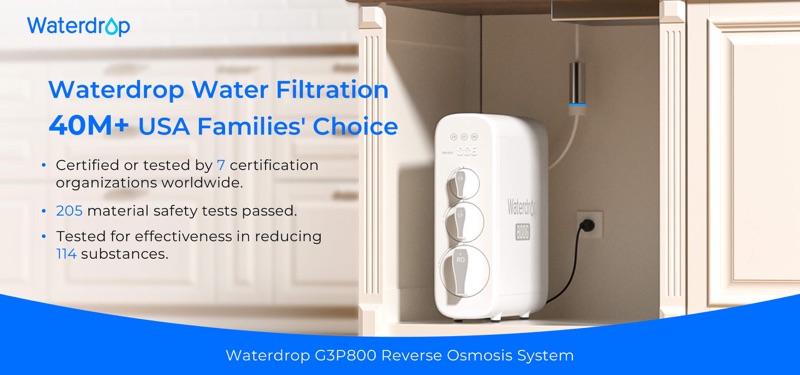
The Waterdrop G3P800 is a compact, tankless under-sink reverse osmosis system that delivers 800 gallons per day without the bulky storage tank found on older RO units. Its 10-stage filtration process is NSF/ANSI certified to standards 42, 53, and 58, covering aesthetic reduction, health contaminant reduction, and reverse osmosis performance respectively. PFAS reduction is documented across multiple independent tests, with results showing greater than 94% removal for PFOA and PFOS. The 3:1 pure-to-drain ratio is among the most efficient in its class, meaning less water wasted compared to older 4:1 or 5:1 systems.
- Filtration Technology: 10-stage reverse osmosis
- Flow Rate: 800 GPD (no waiting for tank refill)
- NSF Certification: NSF/ANSI 42, 53, 58, 372
- PFAS Reduction: Greater than 94% for PFOA/PFOS
- Pure-to-Drain Ratio: 3:1 (efficient vs industry average 4:1)
- Filter Life: Up to 24 months (composite filter)
- Installation: Under-sink, DIY-friendly, no tank needed
- Dimensions: Slim profile, fits most under-sink cabinets
✓ Pros
- Tankless design saves significant under-sink space
- NSF 42, 53, and 58 certified -- not just claimed
- 800 GPD means instant flow with no tank depletion
- Smart LED indicator tracks filter life accurately
- 3:1 drain ratio wastes less water than most competitors
- 2-year filter life reduces annual maintenance cost
✗ Cons
- Higher upfront cost than traditional tank RO systems
- Removes beneficial minerals along with contaminants (consider a remineralization filter add-on)
- Requires dedicated faucet hole or drilling for the smart faucet
Our Verdict
If you want the most effective, best-documented PFAS removal available at a reasonable price, the Waterdrop G3P800 is the clear choice. NSF certification is not just marketing here -- it covers NSF 58 (the reverse osmosis standard) which specifically addresses TDS reduction, fluoride, and health contaminants including PFAS-class compounds. The tankless design makes it practical for any kitchen without sacrificing performance. For households on city water with detected or suspected PFAS, this is the system to install.
Express Water 3-Stage Whole-House Water Filter System
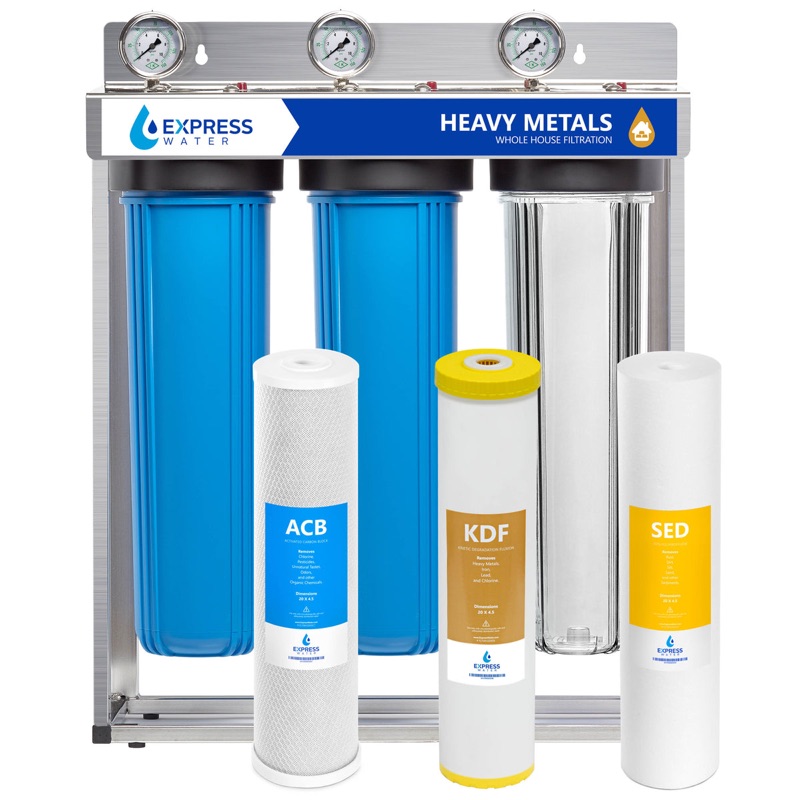
The Express Water whole-house filter system installs at the main water line and treats every tap, shower, and appliance in the home. The three-stage design combines a sediment pre-filter, a heavy metal and anti-scale media filter, and a high-capacity carbon block stage that targets PFAS, chloramine, chlorine, lead, and arsenic. This is not an RO system -- it does not achieve the same PFAS reduction rates -- but it provides a meaningful first line of defense for the entire household and significantly reduces the load on any point-of-use filters downstream.
- Filtration Stages: 3-stage (sediment, heavy metal/anti-scale, carbon block)
- Connects To: Main water line (whole-house)
- Filter Housing: 4.5 x 20 inch high-capacity cartridges
- Flow Rate: Up to 15 GPM (suitable for most homes)
- Target Contaminants: PFAS, lead, arsenic, chlorine, chloramine, scale
- Filter Life: 6 to 12 months depending on water quality
- Connection Size: 1-inch inlet/outlet
- Warranty: 1 year
✓ Pros
- Protects every tap, shower, and appliance in the home
- Reduces PFAS exposure during showering and bathing
- High-capacity cartridges reduce filter change frequency
- Pressure gauges on each stage make monitoring easy
- Significantly more affordable than whole-house RO systems
✗ Cons
- Does not achieve RO-level PFAS removal rates for drinking water
- Professional plumbing installation recommended
- Replacement cartridges are an ongoing cost
Our Verdict
The Express Water whole-house system is the right choice for homeowners who want PFAS reduction at every point of use, not just the kitchen tap. It pairs well with an under-sink RO unit for a layered approach: the whole-house system handles showers, laundry, and appliances, while the RO handles drinking and cooking. For heavily contaminated water, do not rely on this system alone -- combine it with an RO at the tap. For city water with moderate PFAS concern, this system provides solid whole-home protection at a fraction of the cost of a whole-house RO system.
APEC ROES-50 Essence Series 5-Stage Under-Sink RO System
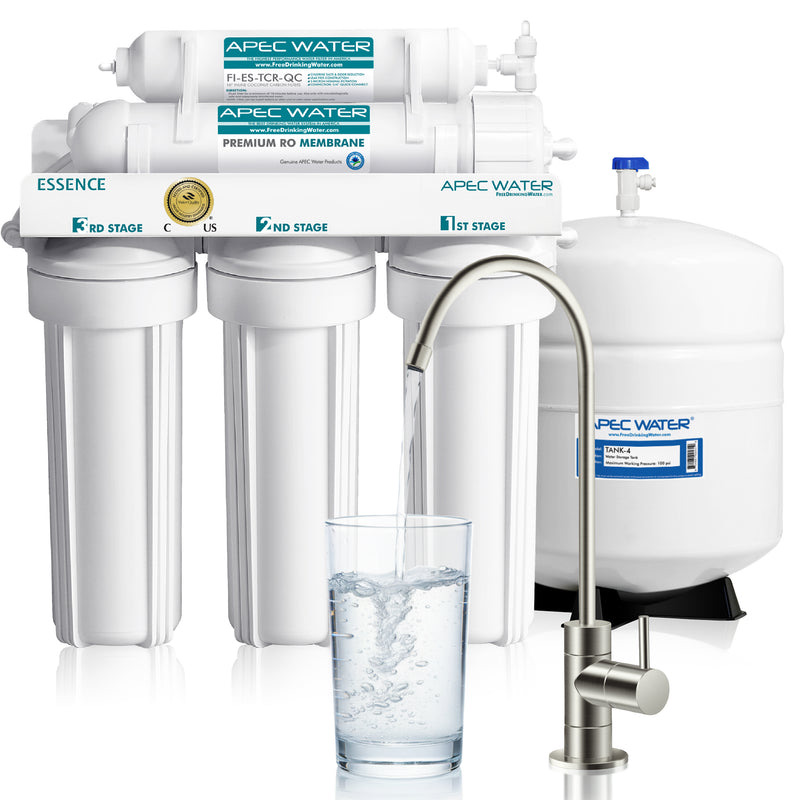
The APEC ROES-50 has been one of the best-selling under-sink reverse osmosis systems for over a decade, and for good reason. Its 5-stage system includes two carbon pre-filters, a high-rejection RO membrane, and two carbon post-filters that polish the water before it reaches the tap. WQA certified to NSF/ANSI standards, it removes PFAS, lead, VOCs, fluoride, arsenic, chromium-6, and hundreds of other contaminants. The storage tank holds 3.2 gallons, which is sufficient for most households. APEC builds this system in the United States and backs it with strong US-based customer support.
- Filtration Stages: 5 (2 carbon pre-filters, RO membrane, 2 carbon post-filters)
- Capacity: 50 GPD production rate
- Tank Size: 3.2 gallons storage
- PFAS Reduction: Greater than 94% (RO membrane, WQA data)
- NSF/WQA Certification: WQA Gold Seal certified
- Filter Life: Pre/post filters 12 months; membrane 2 to 3 years
- Built In: USA
- Warranty: 1 year, US-based support
✓ Pros
- One of the most reviewed and proven RO systems available
- WQA Gold Seal certification provides third-party verification
- US-made components and excellent domestic customer support
- Affordable upfront cost for a fully certified RO system
- Easy DIY installation with detailed instructions included
✗ Cons
- Requires under-sink tank (takes up cabinet space)
- 50 GPD production rate is slower than newer tankless models
- Tank can run low under heavy use
Our Verdict
For households that want verified PFAS removal at a budget-friendly price, the APEC ROES-50 remains one of the most reliable options on the market. It may not have the tankless design or high GPD output of newer systems, but its WQA certification, proven performance history, and US-built quality make it a low-risk, high-trust purchase. If you are installing your first RO system and want peace of mind without overspending, start here.
Clearly Filtered Water Pitcher
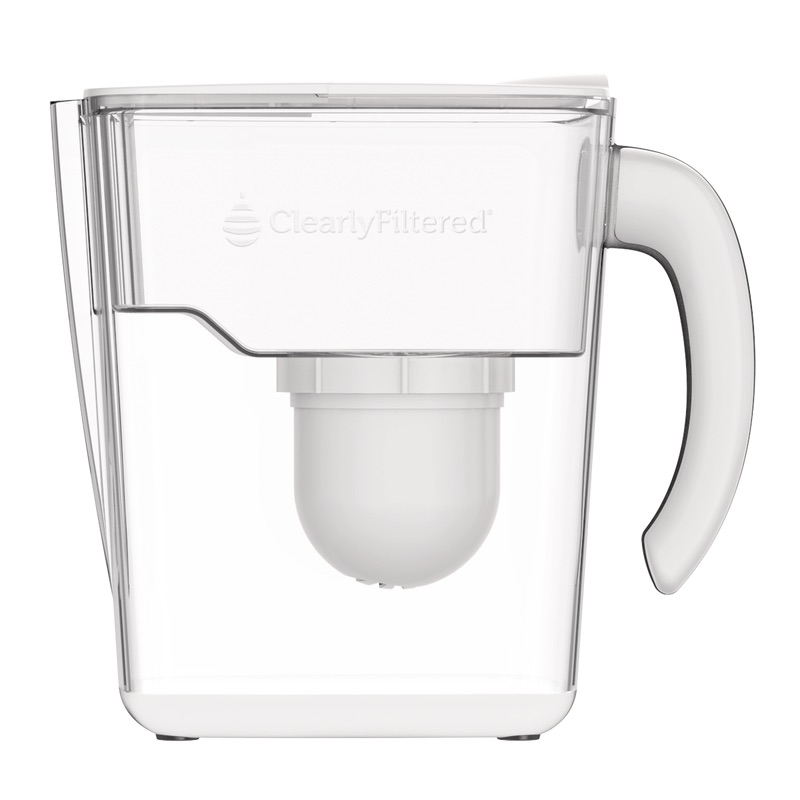
The Clearly Filtered pitcher uses a proprietary Affinity Filtration technology, an advanced activated carbon block system, to target more than 365 contaminants from tap water. This includes PFOA, PFOS, PFAS compounds, fluoride, lead, arsenic, microplastics, and chlorine. It is one of the few pitchers to have undergone third-party testing specifically for PFAS removal and achieves results that standard pitchers such as Brita or PUR cannot match. For renters, apartment dwellers, or anyone who cannot install a permanent system, this is the best no-install option for PFAS reduction.
- Technology: Affinity Filtration (activated carbon block)
- Contaminants Targeted: 365+ including PFOA, PFOS, fluoride, lead, arsenic
- Certification: WQA tested; NSF P473 recertification in progress
- Filter Life: 100 gallons (approximately 2 to 4 months)
- Capacity: 10-cup pitcher
- BPA/BPS Free: Yes
- Installation: None required
- Warranty: Limited lifetime on pitcher
✓ Pros
- No installation required, works anywhere
- One of the only pitchers independently tested for PFAS removal
- Removes fluoride, which most pitchers cannot
- BPA and BPS free construction throughout
- Significantly outperforms standard Brita and PUR pitchers on PFAS
✗ Cons
- Higher replacement filter cost than budget pitchers
- Filters water slowly compared to an RO system on demand
- Does not protect shower or laundry water
Our Verdict
The Clearly Filtered pitcher is the right tool for a specific situation: you need PFAS reduction for drinking water, you cannot or do not want to install anything permanent, and you are willing to pay more for a filter that actually works. If you own your home and can install an under-sink system, go that route instead. But for renters or as a secondary unit for the office or bedroom, this pitcher stands far above the alternatives in its category. If you are weighing it against the other certified-for-PFAS pitcher, our ZeroWater vs Clearly Filtered comparison breaks down lifespan, cost per gallon, and which one fits your tap water profile.
Express Water RO5DX 5-Stage Under-Sink Reverse Osmosis System
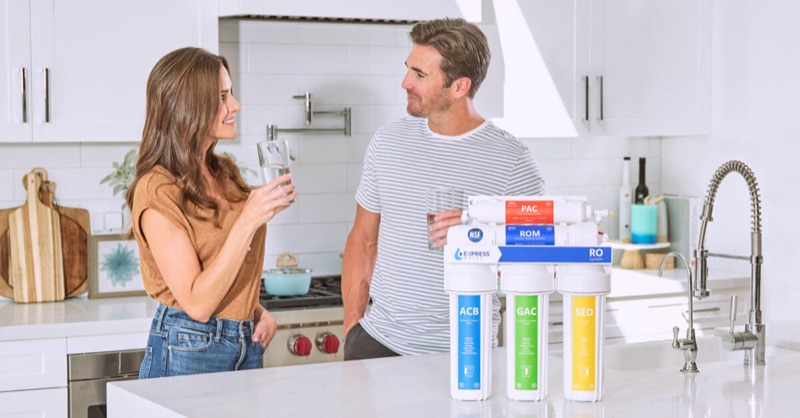
The Express Water RO5DX is a straightforward five-stage reverse osmosis system built for households that want RO-level PFAS removal without the higher cost of premium tankless units. The system includes a sediment pre-filter, two carbon block stages for chlorine and PFAS reduction, a high-rejection RO membrane, and a final post-carbon polishing filter. NSF-certified filter components verify performance, and the system handles up to 50 gallons per day with a standard 3.2-gallon tank. Installation is DIY-friendly and typically completed in under two hours.
- Filtration Stages: 5 (sediment, dual carbon block, RO membrane, post-carbon)
- Capacity: 50 GPD
- Tank Size: 3.2 gallons
- PFAS Reduction: Greater than 90% (via RO membrane)
- NSF Certified Filters: Yes
- Filter Life: 6 to 12 months for carbon stages; 2 years for membrane
- Installation: DIY under-sink, typically under 2 hours
- Warranty: 1 year
✓ Pros
- Lowest price point for a verified RO-based PFAS removal system
- Easy DIY installation with color-coded tubing
- NSF-certified replacement filters are widely available
- Includes leak detector for peace of mind
- Good option for smaller households with moderate water use
✗ Cons
- 50 GPD can feel slow under heavy use
- Requires tank (less space-efficient than tankless models)
- Not the most efficient water use (older drain ratio)
Our Verdict
The Express Water RO5DX is the entry point for anyone who wants true reverse osmosis PFAS removal at the lowest possible cost. It performs the core job well and uses certified filter components. You give up efficiency and speed compared to the Waterdrop G3P800, but you save roughly $150 to $200 on the purchase price. For a single person, couple, or small household that does not run heavy water demands, this system is a solid, no-frills choice.
How to Choose a Water Filter for PFAS
Step 1: Test Your Water First
Before spending money on any filter system, get a certified lab test for PFAS. A standard home water test will not include PFAS -- you need to specifically order a PFAS panel from a certified lab. SimpleLab's Tap Score PFAS Advanced test and National Testing Laboratories both offer mail-in kits for $150 to $400. Knowing your specific contaminant levels and which PFAS compounds are present helps you choose the right filtration technology and verify that your filter is performing after installation. If you are on municipal water, your utility publishes an annual Consumer Confidence Report which may include PFAS data -- check it before assuming your water is clean.
Step 2: Choose the Right Technology for Your Situation
Reverse osmosis is the gold standard for PFAS removal from drinking water. If you own your home and can install an under-sink system, an RO unit is the most cost-effective and thoroughly documented approach. If you rent or cannot install plumbing modifications, a certified carbon block pitcher such as the Clearly Filtered is your best option. For whole-home protection, a carbon block whole-house system reduces PFAS at every tap and shower, but it should be paired with an under-sink RO unit for drinking water if PFAS levels in your water are elevated. Do not rely on standard GAC filters, refrigerator filters, or basic pitcher filters for PFAS removal -- most are not certified for it.
Step 3: Look for Third-Party Certification, Not Just Claims
Many water filter brands claim PFAS removal without independent verification. The certifications that matter are NSF/ANSI 58 (covers RO systems), NSF/ANSI 53 (covers health contaminant reduction), and NSF P473 (specifically addresses PFOA and PFOS reduction). WQA Gold Seal certification follows NSF standards and is equally credible. If a product page only lists internal lab testing without naming a certifying body, treat the claim with skepticism. NSF maintains a public product certification database at nsf.org where you can verify any system's certification status before purchasing.
Step 4: Factor In Total Cost of Ownership
The purchase price is only part of the cost. Calculate annual replacement filter costs before committing to a system. A $150 pitcher with $80 replacement filters every two months costs $480 per year to operate. A $350 under-sink RO system with $60 annual filter costs operates far more economically over time. Tankless RO systems with longer-life composite filters can push annual maintenance costs below $50. Compare the total two-year cost, not just the sticker price, when evaluating your options.
Step 5: Verify Performance After Installation
Once your system is installed, retest your water after 30 days of use to confirm PFAS levels have dropped to below EPA MCL limits. This is particularly important if you are relying on the system for health protection. An $80 to $150 follow-up PFAS test is a worthwhile investment to confirm the system is performing as certified. Keep a record of your filter change dates and water test results so you can spot any decline in performance over time.
Frequently Asked Questions
What type of water filter removes PFAS?
Does boiling water remove PFAS?
What is the EPA limit for PFAS in drinking water?
How do I know if my water has PFAS?
Is a whole-house filter or under-sink RO better for PFAS?
Does a Brita filter remove PFAS?
Why Trust WaterFilterGeek?
Our PFAS filter recommendations are based on third-party certification data from NSF International and WQA, independent lab test results published in peer-reviewed and consumer research contexts, and analysis of thousands of verified customer reviews. No manufacturer paid for placement or influenced our rankings. We earn affiliate commissions when you purchase through our links, but our editorial conclusions are drawn before any affiliate relationship is considered.
Bottom Line
For most households, the Waterdrop G3P800 is the best water filter for PFAS. Its NSF-certified reverse osmosis technology delivers greater than 94% PFAS reduction at the tap, the tankless design saves under-sink space, and the 2-year filter life keeps maintenance simple. Homeowners who want whole-house PFAS coverage should add the Express Water 3-Stage whole-house system at the main line. Renters and apartment dwellers who cannot install anything permanent should use the Clearly Filtered pitcher, which significantly outperforms standard pitchers for PFAS removal. Whatever system you choose, pair it with a certified lab water test before and after installation to confirm actual performance. For more on comprehensive water treatment, see our guides on best well water filters and best water softeners.